
Dome Roof Calculator
Work out the surface area of a spherical dome or geodesic dome from the base diameter and the rise, with the base area and sphere radius alongside.
Quick answer: a 24 ft diameter dome rising 12 ft is a hemisphere. Its surface is 904.8 sq ft over a base of 452.4 sq ft — exactly twice — on a sphere of radius 12.00 ft.
- Any spherical cap, not just a hemisphere
- Surface-to-base ratio as a shape check
- Applies to a geodesic dome's surface
Dome roof inputs and results
Rise is the vertical height of the cap; at half the diameter the dome is a full hemisphere.
The cap area is exact for a smooth shell. A faceted dome needs its own panel takeoff.
Show calculation
What this calculator works out
A dome is a spherical cap: the part of a sphere above a horizontal cutting plane. That is a much broader family than a hemisphere, and it covers everything from a shallow saucer to more than half a sphere.
The useful property is that the surface area depends only on the base diameter and the rise. You do not need to know the sphere radius to measure it, and you do not need to measure along the curve.
That is worth stating plainly, because almost every general surface-area calculator asks for the sphere radius and the cap height. On a roof you have neither. You have the width across the base and the height at the centre, and that is all anyone can take on site. The formula here is rearranged around those two numbers so the radius never has to be found.
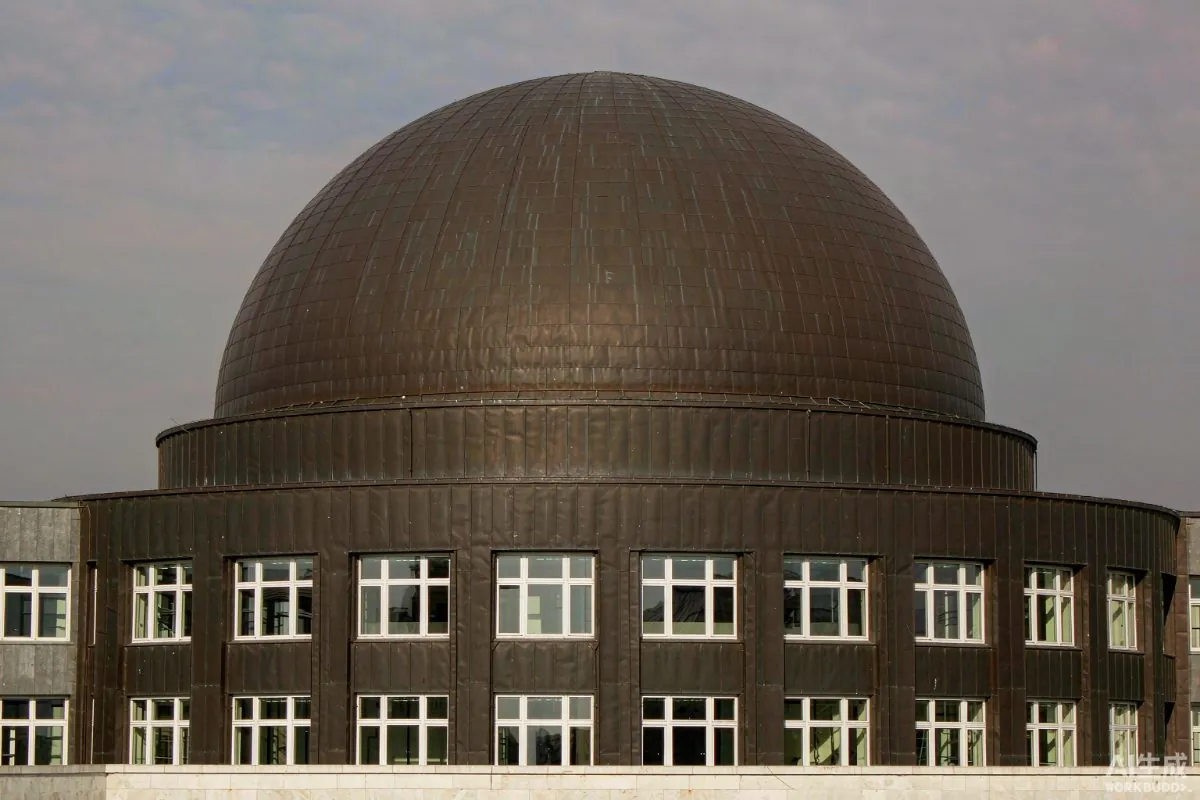
The three inputs and the six results
Two measurements and one allowance. That is the whole input set, and it is why a dome is easier to price than it looks — you never have to measure along the curve.
| Input | Unit | What it is | How to obtain it |
|---|---|---|---|
| Base diameter | ft | The widest dimension across the circle the dome springs from | Measure across the base in two directions and take the larger; a circle should give the same answer twice |
| Rise | ft | The vertical height of the cap from the base plane to the crown | Measure vertically with a straight edge across the base and a tape to the crown — never along the surface |
| Waste | % | Allowance for curved cuts and panel nesting | The covering or panel supplier's figure for the system |
No unit conversion: enter both dimensions in feet. Diameter is capped at 400 ft and the rise at 400 ft, and the waste at 40%.
| Result | Unit | What it means |
|---|---|---|
| Dome surface area | sq ft | π × (base radius² + rise²). The surface you are covering |
| Base area | sq ft | The circle the dome sits on. Not a roofing quantity — a ring beam is ordered against its circumference, not its area |
| Sphere radius | ft | The radius of the sphere the cap is cut from, derived rather than measured |
| Rise | ft | The rise used in the calculation, echoed back so you can confirm the input was read as intended |
| Surface ÷ base | ratio | How much larger the surface is than its own footprint. 2.00 is a hemisphere |
| Squares and area with waste | squares / sq ft | Shown under the headline: area ÷ 100, and area × (1 + waste) |
The ratio is the most useful line on the page and the least obvious. It is a shape check that costs nothing: if you meant a hemisphere and the ratio is not 2.00, one of your two measurements is wrong.
The base circumference is not reported as a result, because it is one multiplication: π × diameter. On the 24 ft default that is 75.40 ft, which is the length to order a ring beam or tension ring against. The base area is not that number, and using it to order a ring is an expensive mistake.
How to Use the Dome Roof Calculator
There is no calculate button. All four outputs update as you type, so the quickest routine is to enter the two dimensions and then read the ratio before you trust the area.
- Measure the base diameter. The widest dimension across the circle the dome sits on. Take it twice, in two directions; if the two readings differ, the base is not circular and this calculator does not apply.
- Measure the rise. Vertically from the base plane to the crown. Lay a straight edge across the base and measure up to it, or measure down from the crown. Measuring along the curve gives a larger number and overstates the area.
- Set the waste allowance. Curved cuts and panel nesting both produce offcuts that cannot be reused. Take the figure from the supplier rather than adding a general percentage.
- Read the ratio before the area. A hemisphere gives exactly 2.00. A ratio near 1.00 means the rise is close to zero and you have measured a flat disc; a very large ratio means the rise dwarfs the diameter, which is usually a tape error rather than a tall dome.
- Read the surface area and the squares. The squares figure is there so the result can sit beside a roofing quote without conversion.
An empty field, a zero rise, or a negative waste produces an error under that field and withholds the result rather than returning a number the shell cannot support.
The formulas
sphere radius = (base radius² + rise²) ÷ (2 × rise)
surface area = π × (base radius² + rise²)
base area = π × base radius²
surface ÷ base = (base radius² + rise²) ÷ base radius²
Surface area of the cap
Formula. Base radius = diameter ÷ 2. Surface area = π × (base radius² + rise²).
Variables. Diameter and rise in feet; the area comes out in square feet. Note that the sphere radius does not appear — it is derived, not measured, and it cancels out of the working.
Why it is calculated this way. The standard result for a spherical cap is two pi R h. Substituting R = (a² + h²) ÷ 2h removes R entirely and leaves pi times the sum of the two squares. That substitution is the whole trick: it turns a measurement you cannot take on site into one you can.
Example. 24 ft diameter, 12 ft rise: base radius 12, so π × (144 + 144) = 904.8 sq ft.
Reading the result. This is exact for a smooth sphere. A faceted dome sits fractionally inside it, which is covered below.
Base area and the surface-to-base ratio
Formula. Base area = π × base radius². Ratio = (base radius² + rise²) ÷ base radius², which simplifies to 1 + (rise ÷ base radius)².
Variables. Both in feet for the area; the ratio is dimensionless, because it is one area divided by another.
Why it is calculated this way. The ratio follows directly from the surface formula once the π and the base radius squared are factored out. It is reported because it is a shape check that needs no extra measurement — a hemisphere must give exactly 2.00, and anything else tells you what you are actually looking at.
Example. A hemisphere: 904.8 ÷ 452.4 = 2.00. A shallow 30 ft dome rising 8 ft: 907.9 ÷ 706.9 = 1.28.
Reading the result. The ratio depends only on rise divided by base radius, so it is scale-free — a 12 ft dome and a 120 ft dome of the same proportion have the same ratio.
| Rise on a 24 ft base | Rise ÷ base radius | Surface ÷ base | Surface area | Shape |
|---|---|---|---|---|
| 6 ft | 0.50 | 1.25 | 565.5 sq ft | Shallow saucer |
| 12 ft | 1.00 | 2.00 | 904.8 sq ft | Hemisphere |
| 18 ft | 1.50 | 3.25 | 1,470.3 sq ft | Tall dome |
| 24 ft | 2.00 | 5.00 | 2,261.9 sq ft | More than half a sphere |
All four rows are this calculator's output on a 24 ft base, whose base area is 452.4 sq ft. The surface does not grow in proportion to the rise: doubling the rise from 6 ft to 12 ft adds 60% to the area, because at shallow rises the base term dominates the sum.
Geodesic domes
A geodesic dome is a sphere approximated by flat triangles. The form is Buckminster Fuller's, and the Buckminster Fuller Institute sets out the principle behind it: a spherical structure built from triangles is far more rigid than the same shell built from rectangles. The vertices lie on the sphere, so the faceted surface sits slightly inside it, but the total area is very close to the spherical area for any practical frequency.
That means the surface area from this page is the right figure for a geodesic dome too. What it does not give you is the panel count.
The facet count comes from the subdivision. A full geodesic sphere at frequency f is divided into 20f² triangles, because an icosahedron has 20 faces and each is split into f² smaller ones. A dome cut from that sphere keeps roughly half of them, but the exact number at the boundary depends on the breakdown method the designer used.
| Frequency | Triangles on a full sphere | Triangles on a half sphere |
|---|---|---|
| 1V | 20 | 10 |
| 2V | 80 | 40 |
| 3V | 180 | 90 |
| 4V | 320 | 160 |
The right-hand column is the idealised half, not a panel schedule. Real domes are cut above or below the equator, and the boundary ring is triangulated differently depending on the method, so the count on a drawing will not match this exactly.
So: use this page for the area and the material quantity, and take the panel schedule from the supplier's drawing. Those are different questions and only one of them is arithmetic.
Domes are one of several non-standard roof forms. If you are comparing shapes, the calculate saltbox roof and calculate sawtooth roof pages cover two other profiles where the surface area does not follow a simple rectangle.
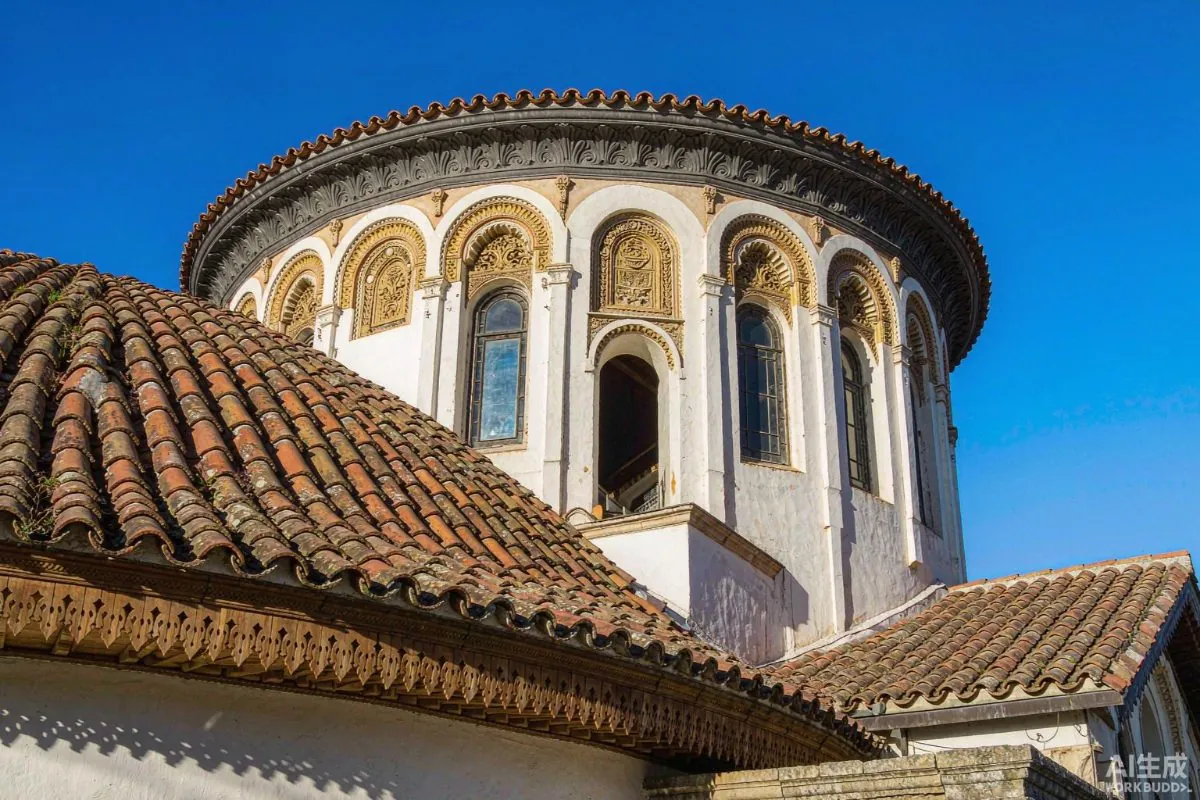
Worked examples
Example 1 — 24 ft diameter, 12 ft rise
- Base radius
- 24 ÷ 2 = 12.00 ft
- Sphere radius
- (144 + 144) ÷ 24 = 12.00 ft
- Surface area
- π × (144 + 144) = 904.8 sq ft
- Base area
- π × 144 = 452.4 sq ft
- Ratio
- 904.8 ÷ 452.4 = 2.00
- Squares
- 9.05
The rise equals the base radius, so the sphere radius equals the base radius and the cap is exactly a hemisphere. The ratio of 2.00 confirms it without any further check.
Example 2 — a shallow dome on a wider base
- Dome
- 30 ft diameter, 8 ft rise
- Base radius
- 15.00 ft
- Sphere radius
- (225 + 64) ÷ 16 = 18.06 ft
- Surface area
- π × (225 + 64) = 907.9 sq ft
- Base area
- π × 225 = 706.9 sq ft
- Ratio
- 1.28
The surface is almost identical to Example 1 despite the base being 56% larger, because the dome is much shallower. The sphere radius is also larger than the base radius — 18.06 against 15.00 — which is the signature of a shallow cap.
Limitations and assumptions
- Spherical cap. An elliptical, onion or bell-shaped dome is not a sphere and needs a profile.
- One rise. A dome that changes curvature toward the crown is not modelled.
- Surface area only. Panel count, facet geometry and fixings are separate.
- No base ring or structure. The base area is a length reference, not a design.
- No openings. Skylights, lanterns and vents remove area that this calculation includes. The FAQ below shows how to subtract the cap you are cutting out.
- Rise above the radius is allowed. The formula still holds, but check that the dome really is spherical.
When this is the wrong shape
A dome curves in two directions at once. If the roof curves in one direction only, it is a barrel vault, and the arithmetic there works from a single arc rather than from a spherical surface.
If it does not curve at all, it is built from planes, and the right tool depends on how they are arranged. A single plane falling one way is a shed roof. Two planes at different pitches make a saltbox, and a repeated single slope in steps makes a sawtooth.
Two steep planes meeting at a ridge with no walls between them is an A-frame. All of those are a pitch factor applied to a footprint, which is a different calculation from this page.
The inputs are not transferable. A dome needs diameter and rise; a vault needs span, rise and length. If you only want the sloped surface of an ordinary pitched roof, the roof square footage conversion is the one you want, and this page will overstate it.
Frequently asked questions
A dome is a spherical cap, and the area of a spherical cap is two times pi times the sphere radius times the cap height. Written in terms of what you can measure, it collapses to pi times the base radius squared plus the rise squared. That means you only need the base diameter and the rise. The sphere radius is derived, not measured.
Because the surface curves away in every direction. A flat disc of the same diameter has area pi r squared; the hemisphere above it has twice that. The ratio of surface to base is reported as a tile because it is a quick sanity check. Two means a hemisphere; anything under two means a shallow dome.
The formula still holds. A shallow cap has a large sphere radius and a small rise, so the surface is only a little more than the base. A 30 ft dome rising 8 ft has a ratio of 1.28, which is a shallow dome — visually flat but still a full spherical surface.
Then the cap is more than a hemisphere. The arithmetic still works, but the shape is a tall dome rather than a half sphere. An onion dome or a bell-shaped dome is not spherical at all, and its area needs a profile rather than a single rise.
The surface area is the same, because a geodesic dome is an approximation of the same spherical surface — the facets lie on the sphere, so their total area is close to it. What differs is the panel count, which depends on the frequency of the subdivision and on how the boundary is handled.
A full geodesic sphere at frequency f is divided into 20f² triangular faces, because an icosahedron has 20 faces and each is split into f² triangles. A dome cut from that sphere keeps roughly half, but the exact count at the boundary depends on the breakdown method. Take the panel schedule from the supplier's drawing rather than from an area figure.
Almost always. The base area reported here is the circle the dome sits on, which is the length to order a ring beam or a tension ring against. The ring itself is a structural element, and its size is not an arithmetic question.
From the base plane to the highest point, vertically. On an existing dome that is easiest with a straight edge across the base and a tape to the crown. Do not measure along the curve. The rise is a vertical distance, and measuring along the surface gives a larger number that will overstate the area.
Yes, if it is genuinely spherical. A turret cap that is conical or bell-shaped is a different surface and needs the cone or the profile instead. If the profile is a circular arc in section and that arc is part of a sphere, this is the right calculation.
More than on a flat surface, because every piece is cut on a curve and the offcuts are not reusable. On a faceted dome the waste also depends on how the panels are nested on the sheet. The allowance is a product decision and the supplier publishes a figure. It is an input here rather than a built-in number.
Subtract the cap you are taking out. The piece above the opening is another spherical cap on the same sphere, so it uses the same formula with the opening's radius and the height of that small cap: π × (radius² + height²). On the 24 ft hemisphere with a 4 ft opening at the crown, the small cap is about 12.7 sq ft, so the dome falls from 904.8 to roughly 892.1 sq ft. Near the crown the surface is almost horizontal, so the area removed is very close to the flat area of the opening itself.
Where these numbers come from
The area of a spherical cap is two pi R h. Substituting the sphere radius derived from the base radius and the rise removes R entirely, leaving pi times the sum of the two squares. That is the form used here, and it is exact for a sphere.
The geodesic facet count of 20f² follows from subdividing each of the twenty faces of an icosahedron into f² triangles. It is stated as a full-sphere figure because the boundary of a partial dome is a design choice.
Neither the cap area nor the facet count is quoted from a table, and that is deliberate. A spherical cap is fully determined by two measurements, so the arithmetic can be checked by hand from the worked examples, and 20f² is the consequence of subdividing an icosahedron rather than a published figure. The only product-specific numbers are the nesting and waste allowances, which differ between panel systems and are inputs here rather than constants.
- Buckminster Fuller Institute, Domes — for the geodesic construction this page builds on: a spherical structure created from triangles. The facet count follows from that construction; it is not a figure taken from the page.
- Your own measurement of the base diameter and the rise.
- The covering or panel supplier's nesting and waste figures.
- The dome designer's panel schedule for facet counts and sizes.
Curved in one direction only?
A barrel vault is a single arc, with a developed width you can order flat material against.