
Shingle Calculator
Work out field shingle bundles, starter strip and ridge cap in one pass, using coverage rates you take from the product rather than figures the calculator invents.
Quick answer: 1,342 sq ft at 10% waste and three bundles per square is 45 field bundles. Add 120 ft of starter and 60 ft of ridge cap and the total is 50 bundles — about $2,000 in shingles at $40 a bundle, plus 4 rolls of underlayment.
- Field, starter and ridge
- Editable coverage rates
- Bundles rounded up
Shingle calculator inputs and results
Bundles are counted per square of the sloped surface, so if you only know the footprint, use the pitch fields to convert it first.
Converts the footprint into the sloped surface the shingles cover.
Bundles per square is on the packaging. Three is common; do not assume it.
Usually the eaves plus the rakes. Enter 0 if you are not using starter strip.
Measure every ridge and hip. Enter 0 if you are not capping.
Use your supplier's price. The low and high estimates apply ±20% to this figure.
Materials
Roof area
Cost estimate
Assumes 10% waste, 3 bundles per square, 1 underlayment roll per 4 squares and 1.25 lb of nails per square. Low and high apply ±20% to your bundle price. Excludes flashing, drip edge, ice-and-water shield and labour.
Show calculation
What this calculator works out
The short answer: roof area in squares, times the bundles the product needs per square, plus waste — then starter strip and ridge cap from their own linear lengths. A 1,342 sq ft roof at three bundles to the square and 10% waste is 45 field bundles, plus 2 of starter and 3 of ridge cap: 50 bundles, in three different products.
Alongside the bundles, the calculator estimates underlayment at one roll per four squares, roofing nails at 1.25 lb per square, and a material cost band built from your own bundle price — so the answer is a shopping list rather than a single figure.
A shingle roof is not one product. It is field shingles across the slopes, starter strip along the edges, and ridge cap over the ridges and hips. Each is sold in its own bundle with its own coverage, and ordering only the field shingles is one of the most common ways a job runs short.
This calculator counts all three. It takes the roof area, converts it to squares, applies your waste allowance, and multiplies by the bundles-per-square figure you enter. Then it adds starter and ridge cap from the linear lengths you measure.

| Bundles per square | Coverage per bundle | Bundles for 20 squares |
|---|---|---|
| 3 | 33.3 sq ft | 60 bundles |
| 4 | 25.0 sq ft | 80 bundles |
| 5 | 20.0 sq ft | 100 bundles |
The roof does not change between those rows — only the number printed on the bundle. Every calculation that divides the area by 33.3 assumes the first row, which is the common case and not the only one. Read the coverage off the product before you trust a bundle count from any calculator, including this one.
What you enter, and what comes back
Nine inputs in three groups: the area, the field coverage, and two linear products.
| Input | What it means | Where it comes from |
|---|---|---|
| Sloped roof area | The surface measured along the slope — or the footprint and pitch | Your measurement, or the footprint fields |
| Length unit | Feet or metres, applied to every length on the page | Your choice |
| Waste | Allowance on the field shingles only | Your judgement, or the waste calculator |
| Bundles per square | Field bundles needed to cover 100 sq ft | The bundle label |
| Starter strip length | Eaves, plus the rakes if the strip runs up them | Measured on the roof |
| Starter per bundle | Linear feet one bundle of starter covers | The bundle label |
| Ridge + hip length | Every ridge and hip, added together | Measured, or worked out from the plan |
| Ridge cap per bundle | Linear feet one bundle of ridge cap covers | The bundle label |
| Result | Unit | How to use it |
|---|---|---|
| Field bundles | bundles | The bulk of the order. Area with waste, converted at the coverage rate. |
| Squares with waste | squares | The roof in the unit suppliers quote, so you can price it before converting to bundles. |
| Starter bundles | bundles | A different product, rounded separately because you cannot buy part of one. |
| Ridge cap bundles | bundles | Also separate, and also rounded on its own. |
| Total bundles | bundles | The three lines added. This is what arrives on the truck, in three different packages. |
The three lines are rounded independently because they are three products. A shortfall in field shingles cannot be made up from a spare starter bundle.
How to use the shingle calculator
- Enter the roof size. Use the sloped area if you have it, or the footprint and pitch if you do not.
- Set waste and bundles per square. Read bundles per square from the product you are buying.
- Measure the starter length. Add the eave runs and the rake runs. If you are not using starter strip, enter 0.
- Measure the ridge and hip length. Add every ridge and every hip. Enter 0 if you are not capping.
- Read the total. Each line is rounded up separately, because each is a separate purchase.
What lengths to enter
The area is the sloped surface, not the footprint, and the gap between the two is the pitch factor. At 4:12 the factor is 1.054, so a 1,200 sq ft footprint carries about 1,265 sq ft of shingle — small enough that most people assume it does not matter.
At 6:12 the same footprint carries 1,342 sq ft, and at 12:12 it carries 1,697. Between the flattest and the steepest of those three is a third of the order, which is why the pitch gets measured rather than assumed.
The two linear inputs are where the order usually goes wrong.
Ridge plus hips, not just the ridge
On a gable the ridge is the only linear feature at the top, so the ridge length and the roof length are the same number. On a hip roof they are nothing alike. A 30 by 40 ft hip roof at 6:12 has a ridge of 10 ft — the length minus the width — and four hips of 16.8 ft each. The length you need is 77 ft, and the ridge is 13% of it.
Enter the ridge alone and you order one bundle of ridge cap for a roof that needs four. It is the largest single under-order this calculator can produce, and it only happens on hips, which is exactly where people are least sure of the geometry.
Starter strip, and whether it runs up the rakes
Some installations use starter only along the eaves; others run it up the rakes as well. On a 40 ft roof with two 18 ft rakes that is 76 ft rather than 40 — nearly double. Whether the extra length buys another bundle depends on where the rounding falls, so measure it rather than assume, and check which detail the specification calls for.
Measure along the slope
Rakes and hips are measured along the surface, not across the plan. A hip that looks like 15 ft on the drawing is 16.8 ft of ridge cap at 6:12, and the difference is the pitch factor doing its usual work.
The formula
Area to squares, squares to bundles, then the two linear products.
squares with waste = (roof area ÷ 100) × (1 + waste ÷ 100)
field bundles = squares with waste × bundles per square, rounded up
starter bundles = starter length ÷ starter coverage, rounded up
ridge bundles = ridge length ÷ ridge coverage, rounded up
total = field + starter + ridge
Rounding happens at the end of each line rather than once at the very end, because you cannot buy part of a starter bundle to make up a shortfall in field shingles. They are different products.
The waste allowance applies to the field shingles only. Starter strip and ridge cap are counted from measured linear lengths, so their offcut is already implicit in those measurements.
Worked examples
Both are reproduced by the calculator above with the values shown.
Example 1 — 1,342 sq ft with starter and ridge cap
- Squares
- 1,342 ÷ 100 = 13.42
- Squares with waste
- 13.42 × 1.10 = 14.762
- Field bundles
- 14.762 × 3 = 44.29 → 45
- Starter
- 120 ft ÷ 100 ft per bundle = 1.2 → 2
- Ridge cap
- 60 ft ÷ 20 ft per bundle = 3 → 3
- Total
- 45 + 2 + 3 = 50 bundles
Ordering only the field bundles would leave the job two starter bundles and three ridge cap bundles short.
Example 2 — 120 m², field shingles only
- Area in sq ft
- 120 ÷ 0.09290304 = 1,291.7 sq ft
- Squares with waste
- (1,291.7 ÷ 100) × 1.10 = 14.21
- Field bundles
- 14.21 × 3 = 42.63 → 43
With the starter and ridge lengths left at zero, the total equals the field count. Metric areas are converted to square feet because a square is defined as 100 sq ft.
The three products, and why they are counted separately
Field shingles cover the slopes. They are the bulk of the order and the only part that scales with roof area.
Starter strip is the first course at the eaves and up the rakes. It is usually a narrower roll or a purpose-made strip with an adhesive band, and its coverage is quoted in linear feet per bundle, not square feet. Some installers make starter by cutting tabs from field shingles; that changes the arithmetic and uses field material instead. If you are buying purpose-made strip, the roof starter strip calculator takes the eave and rake lengths directly and returns pieces as well as bundles.
Ridge cap covers ridges and hips. It is a folded or pre-formed shingle sold by linear coverage, and the figure varies widely between products, which is why the calculator asks for it.
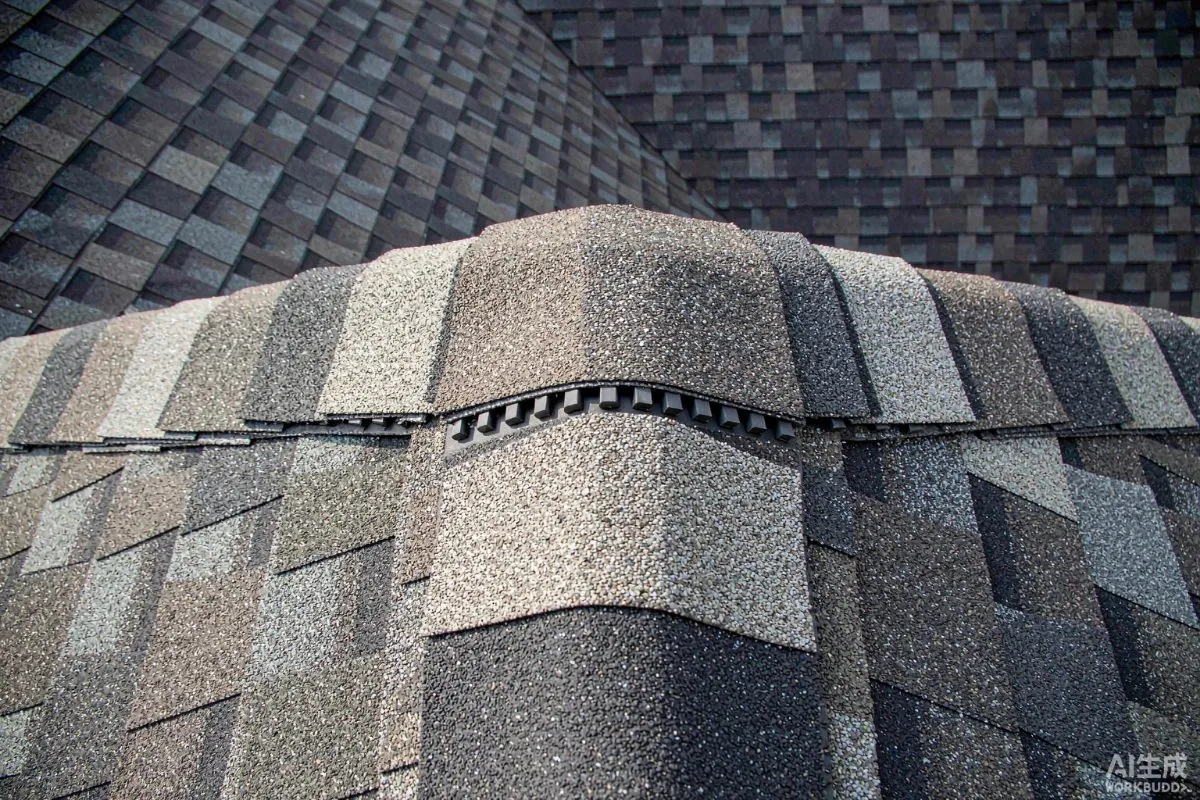
| Product | Sold by | Coverage input | Scales with |
|---|---|---|---|
| Field shingles | Bundle | Bundles per square | Roof area |
| Starter strip | Bundle or roll | Linear ft per bundle | Eave and rake length |
| Ridge cap | Bundle | Linear ft per bundle | Ridge and hip length |
Coverage figures differ by manufacturer and product line. Use the figure on the product, not the default.
Specification: type, brand and offset
Three things get decided before any quantity is calculated, and none of them is arithmetic. They change what you buy and how much you waste, but they are choices rather than results.
Comparing types
The main families differ in construction and in what they are rated for. The quantity arithmetic is the same for all of them; what changes is the coverage per bundle, which you enter.
| Type | What it is | What to check before ordering |
|---|---|---|
| Three-tab | A single layer with cut tabs | Tabs per strip and strips per square |
| Laminated | Two or more layers bonded, thicker profile | Bundles per square, which is lower than three-tab |
| Impact resistant | Reinforced mat, rated for hail | The rating class, and whether it changes the fixing pattern |
| Recycled rubber | Synthetic, often lighter | Whether the product is rated for your pitch and fixing method |
No coverage figure is given here, because it varies by product line. Take it from the bundle.
Brand comparison is the same question at a finer grain. Two products of the same type can differ in bundles per square, in what a "square" covers, in warranty terms and in the fixing pattern they require. The one that matters for this calculator is coverage per bundle, because it is the divisor.
Course offset
Courses are staggered so that the joints between strips do not line up vertically. Aligned joints form a continuous path for water and a weak line for wind, so the offset is a requirement rather than a preference.
The usual pattern is a half-tab offset, with each course shifted by half the tab width from the one below. Some products specify a different figure, and some specify a random offset to avoid a visible pattern on the roof.
Offset does not change the area, but it changes where the cuts fall at the rakes and verges, and therefore how much of each strip is usable. A roof laid with a large offset wastes more at the edges than one laid with a small one — which is one of the reasons the waste allowance is a judgement rather than a constant.
Where the offset meets a hip or a valley, the cut is diagonal and the offcut usually has no second use. That is the waste the allowance is really covering.
Limitations and assumptions
- Shingles only. Underlayment, fasteners, drip edge, valley flashing, vents and ice barrier are excluded.
- No deck. The panels the shingles are fixed to are a separate takeoff, sized by the roof sheathing calculator from the same sloped area.
- No adhesive or sealant. Shingle adhesive, cap mastic and the sealant used at penetrations are separate products with their own coverage rates. Where the roof is bonded rather than nailed — a membrane rather than shingles — that quantity is the roof adhesive calculator's job.
- One pitch assumed for the area figure. If the roof has more than one pitch, calculate each area and add the bundle counts.
- Coverage rates are yours. The defaults are typical, not authoritative. Confirm against the product data.
- No layout design. The calculator does not plan courses, offsets or where cuts fall. A real layout can waste more than the percentage entered.
- Not a specification. It does not confirm that a product, nailing pattern or underlayment is suitable for your roof, slope or wind zone.
Before you order
Five checks that catch the errors the arithmetic cannot.
- Read the coverage off the bundle, not the default. Bundles per square and the linear coverage of starter and ridge cap all vary by product line, and all three are divisors. A laminated product that needs four bundles to the square rather than three is a third more material on the same roof.
- Confirm the starter detail. Eaves only, or eaves and rakes. It is a specification decision, and it changes the length by nearly half on a typical house.
- Order the underlayment as its own line. It is measured by area with its own roll size and side lap, and on slopes below 4:12 it may need two layers. The roof underlayment calculator works from the same sloped area.
- Look at the deck before the shingles arrive. Soft sheathing, popped nails and delamination are discovered when the old covering comes off, and they change the order more than any waste percentage.
- Price it once the quantity is settled. Bundles, underlayment and labour are three rates, and the shingle cost calculator puts them together with your own figures rather than a national average.
Bundles are heavy and they do not improve with storage. Keep them flat, off the ground and covered, and do not break the wrapper on a bundle you will not open that week — the seal is what keeps the mat from taking on water before it is laid.
Roof Pitch Resources and Guides
Reference values for the pitches you are most likely to be converting.
Roof Pitch Chart
Every common pitch in one table: degrees, slope percentage, pitch factor and rafter length per 12 of run.
Read the reference6/12 Roof Pitch
26.57°, a 50% slope and a pitch factor of 1.118 — the pitch used in most worked examples.
Read the reference4/12 Roof Pitch
18.43° and a 33.33% slope. A moderate roof near the shallow end for many coverings.
Read the reference3/12 Roof Pitch
14.04° and a 25% slope, common on porches, lean-tos and outbuildings.
Read the reference2/12 Roof Pitch
9.46° and a 16.67% slope — the shallow end of what is usually still called a pitched roof.
Read the reference8/12 Roof Pitch
33.69° and a 66.67% slope. A steep roof with noticeably more surface per square foot of footprint.
Read the reference12/12 Roof Pitch
45°, a 100% slope and a pitch factor of 1.414, where rise equals run.
Read the referenceFrequently asked questions
Work out the roof area in squares (100 sq ft each), add your waste allowance, then multiply by the number of bundles the product needs per square. For 1,342 sq ft at 10% waste and three bundles per square: 13.42 × 1.10 = 14.76 squares, and 14.76 × 3 = 44.3, so 45 bundles of field shingles.
It is a product specification, not a universal constant. Three bundles per square is common for asphalt shingles, but some product lines are four or even five bundles per square, and synthetic or designer products differ again. The calculator makes bundles per square an editable field so you can enter the figure from the packaging or the manufacturer's data sheet.
Usually yes. Starter strip is a dedicated first course along the eaves and up the rakes, and most shingle manufacturers specify it as part of a compliant installation because it seals the edge courses and helps resist wind uplift. Some installers cut starter from field shingles instead. Either way it is material that the field-shingle figure does not include, which is why it has its own line here.
Measure the total length of every ridge and hip, then divide by the coverage of one bundle of ridge cap. Coverage varies by product — many ridge cap bundles cover somewhere in the region of 20 to 35 linear feet, but the figure on the product is the one to use. The calculator asks for the coverage rather than assuming it.
It depends on the roof. A plain gable with two long slopes produces little offcut. A roof with multiple hips, valleys, dormers and short runs produces a lot, because every junction needs cut pieces. Ten percent is a common starting point for a straightforward roof, but it is an assumption you should adjust. Ask your supplier what they would allow for your roof type rather than treating the default as correct.
Ordering a spare bundle or two is common practice, partly for breakage and partly because shingle colours can vary between production runs, which makes a later match difficult. That decision is yours, not the calculator's. The result already includes the waste percentage you entered, so add any deliberate spares on top of it.
No. It counts shingles, starter strip and ridge cap only. Underlayment, fasteners, drip edge, valley flashing and ventilation are separate items with their own coverage rates. Underlayment in particular is ordered by the roll, and the number of rolls depends on the product width and the roof area, so take it from the manufacturer's coverage data.
Multiply the plan area by the pitch factor, √(1 + (pitch ÷ 12)²). At 6:12 the factor is 1.118, so a 1,200 sq ft footprint is about 1,342 sq ft of roof. The footprint tab does this for you. If the roof has more than one pitch, convert each area separately and add them.
Follow the manufacturer's nailing pattern for the product and the wind zone. Four nails per shingle is a common requirement for standard three-tab, and six is common where higher wind resistance is needed or specified. Nail placement matters as much as the count: nails go in the manufacturer's designated nail line, not above or below it. Nail quantity is not part of this calculator.
The squares figure is valid for any covering, because a square is 100 sq ft. The bundle logic is specific to products sold by the bundle. Metal panels are ordered by length and profile coverage, and tiles by piece count with a product-specific coverage per square, so use the squares figure and apply the supplier's own conversion.
Because the total adds starter strip and ridge cap. Those are separate products with their own coverage rates, and they are bought as their own bundles. If you leave the starter and ridge lengths at zero, the total equals the field shingle count.
Multiply the total bundle count by your supplier's price. At $40 a bundle, 50 bundles is about $2,000. The calculator also shows a low and high band that applies plus or minus 20% to your price, because bundle prices move with region, brand and warranty length. The estimate covers field shingles, starter strip and ridge cap only; underlayment, fasteners, flashing and labour are separate.
As a working rule, allow one roll of synthetic underlayment per four squares, so 14.76 squares needs four rolls. Roofing nails run at roughly 1.25 lb per square, which puts the same roof at about 18.5 lb. Both are estimates: roll coverage and nail quantity change with the product data sheet and the nail length, so check the manufacturer's figures before ordering.
Where these numbers come from
The arithmetic is area division and linear division. A roofing square is 100 sq ft, and bundle and linear coverage are read from the product rather than assumed here.
Installation requirements — starter course, nailing, valley treatment and minimum slope — come from the product manufacturer and from the roofing chapter of the residential code adopted in your area.
- Asphalt Roofing Manufacturers Association (ARMA), residential asphalt shingle application guidance.
- International Code Council, International Residential Code, roof covering provisions.
- Shingle manufacturer installation instructions and product data sheets for bundle and linear coverage.
This page calculates quantities. It does not certify that a particular product or installation meets the requirements for a particular roof.
Need the roof area first?
Bundle counts start from the sloped surface. Convert a footprint to roof area, or go straight to squares.