
Roof Adhesive Calculator
Work out how many gallons of membrane adhesive a roof needs from the area, the coverage rate and the number of coats — plus the seam tape to go with it.
Quick answer: 1,000 sq ft at 60 sq ft per gallon, one coat and 10% waste needs 19 gallons — 4 pails of 5 gallons — plus 2 rolls of seam tape for 100 ft of seam.
- Gallons, pails and seam tape
- Coats applied to the whole area
- Coverage rate from the product
Adhesive inputs and results
Published coverage assumes a smooth, primed substrate; a porous deck can take half again as much.
- Membrane area (sq ft)
- Coverage (sq ft per gallon)
- Coats
- Seam length (ft)
- Tape roll length (ft)
- Waste (%)
Adhesive is rounded up to whole pails, so coverage ordered exceeds coverage required.
Show calculation
What this calculator works out
Membrane adhesives are sold by volume and specified by coverage — square feet per gallon. The quantity is therefore a division, and the two things that move it most are the coverage rate and the number of coats.
This page returns gallons, the pails they come in, and the seam tape for the joins. It treats the field bond and the seams as separate quantities, because they are bought separately and follow different measurements.
The membrane bonds either to the deck or to a separating layer over it, and which one changes the coverage rate rather than the arithmetic. A roof underlayment is a separate takeoff; the rate for bonding to it is a separate line on the data sheet.
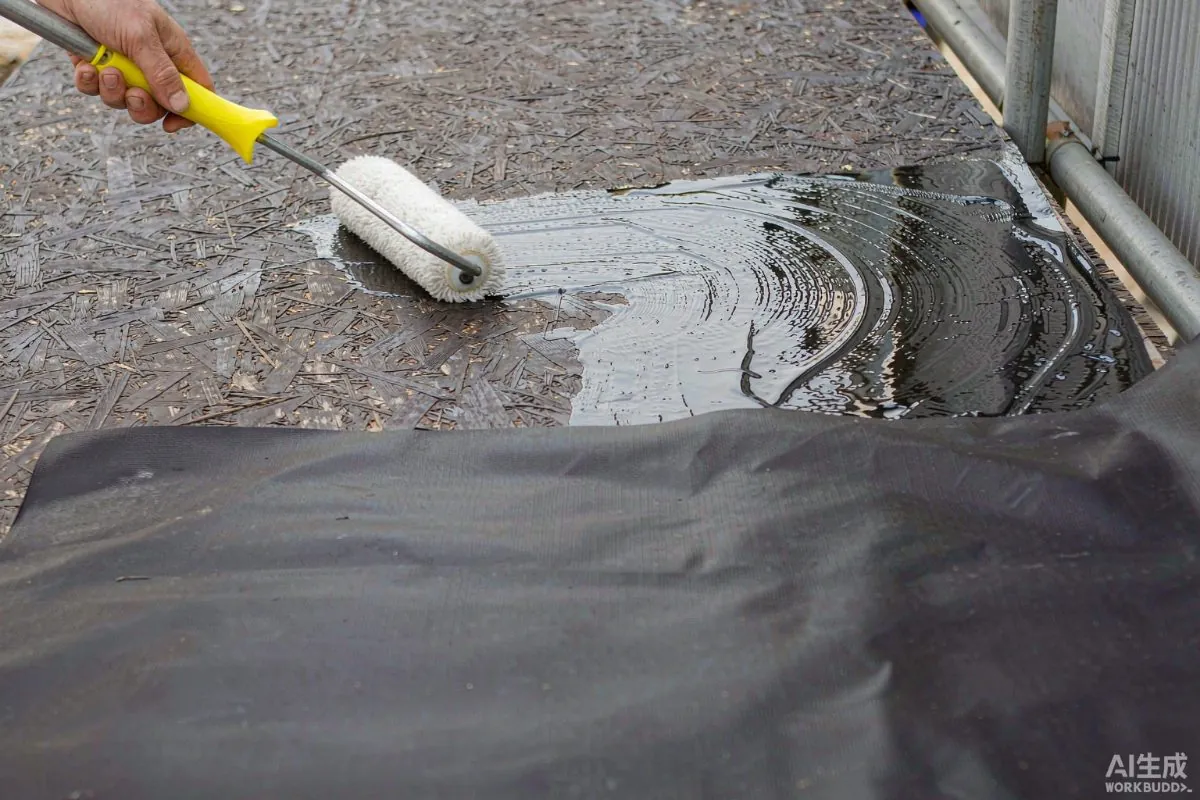
What you enter, and what comes back
Six inputs, and two of them are not measurements.
| Input | What it means | Where it comes from |
|---|---|---|
| Membrane area | The flat area being bonded, with no pitch factor | Your measurement |
| Coverage | Square feet one gallon covers on your substrate | The product data sheet — not the best case |
| Coats | One or two, as the specification requires | The specification |
| Seam length | The length of every join, which is derived rather than measured | Joints × run length — one fewer joint than panels |
| Tape roll length | Feet on one roll of seam tape | The label |
| Waste | Allowance for residue in the pail and loss in the pump | Your judgement |
| Result | Unit | How to use it |
|---|---|---|
| Adhesive required | gal | The volume to buy, waste included. |
| Pails | 5 gal | Rounded up. Drums need dividing by their own size. |
| Seam tape | rolls | Rounded up, because splices in tape are not permitted. |
| Coverage ordered | sq ft | Pails bought × coverage. The surplus is rounding, not extra adhesive. |
The membrane area needs no pitch factor because a bonded membrane roof is flat. The seam length is the only figure on this page you cannot put a tape on directly.
How to use the roof adhesive calculator
Two measurements and three figures from the product.
- Enter the membrane area you are bonding.
- Enter the coverage rate from the data sheet for your substrate.
- Enter the number of coats.
- Enter the total seam length and the tape roll length.
- Set the waste allowance and read the gallons.
If the answer looks large, check the coats first. Two coats doubles everything, and it is the input most often entered by mistake.
Seam length is the one input you cannot measure directly. Count the joins — one fewer than the number of panels across — and multiply by the distance up the slope. A roof 40 ft up the slope, covered in four panels across, has three seams of 40 ft, so 120 ft of seam.
| Field | Unit | What it is | Where it comes from |
|---|---|---|---|
| Membrane area | sq ft | The area being bonded | Measured on plan — the roof is flat, so there is no pitch factor |
| Coverage rate | sq ft per gal | The product's published rate | The data sheet, for your substrate and film thickness |
| Coats | count | Applications on each face | The data sheet — one coat per face is not two coats on one face |
| Seam length | ft | Total length of the joins | Number of seams × distance up the slope |
| Tape roll length | ft | The roll size you are buying | The product listing |
| Waste | % | Residue left in the pail, roller and tray | 10% is a fair default; it is not a covering offcut allowance |
| Adhesive required | gal | Area with waste × coats ÷ rate, rounded up | The volume to order |
| Pails | count | Gallons ÷ 5, rounded up | What you actually buy, so always slightly more |
| Seam tape | rolls | Seam × (1 + waste) ÷ roll length, rounded up | One continuous run per seam, so the count rounds up |
| Coverage ordered | sq ft | Gallons bought × rate | Always at or above the area with waste; the gap is rounding |
The formulas
gallons = ⌈ area with waste × coats ÷ coverage ⌉
pails = ⌈ gallons ÷ 5⌉
tape rolls = ⌈ seam length × (1 + waste ÷ 100) ÷ roll length⌉
The gallons are rounded up before the pail count, so the pails always cover the calculated volume. Rounding only at the end would let a part-pail shortfall through.
The coverage ordered figure is the gallons actually bought multiplied by the rate. It is always at or above the area with waste, and the difference is the rounding.
The waste allowance in the first line is doing a specific job here: it covers what stays in the pail, the roller and the tray. That is a different thing from the roof waste you would add to a covering order, where the loss is offcuts rather than residue.
Coats and coverage
Two numbers decide the order, and they pull in opposite directions. A higher coverage rate means less adhesive; more coats means more. Confusing the two is easy because both are described in the same sentence on a data sheet.
A contact adhesive is often specified as one coat on each surface. That is two applications but one coat per face, so it is not the same as two coats on one face — and the difference is a factor of two in the quantity.
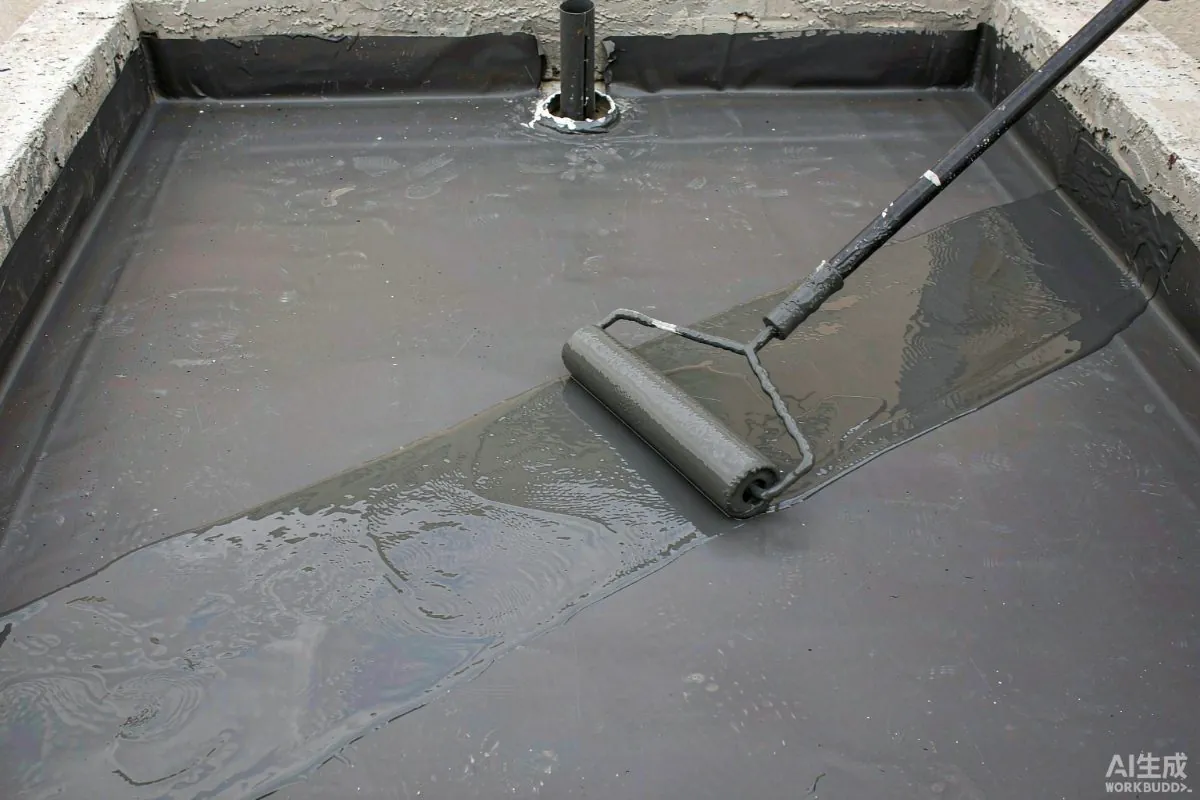
Cure and working time
How long an adhesive takes to cure is not a quantity, and it is not something this page calculates. It depends on the product chemistry, the temperature of the air and the deck, the humidity, and the thickness of the film.
A solvent-based contact adhesive flashes off quickly in warm dry weather and slowly in cold damp conditions. A water-based product behaves differently again. The data sheet gives a working range and often a minimum and maximum open time — the window between the adhesive becoming tacky and it becoming too dry to bond.
Outside that window the joint fails, and no quantity of extra adhesive fixes it. If the conditions are outside the range, the correct action is to wait rather than to use more product.
Worked examples
Example 1 — 1,000 sq ft, 60 sq ft per gallon, one coat
- Area with waste
- 1,000 × 1.10 = 1,100 sq ft
- Gallons
- ⌈1,100 ÷ 60⌉ = ⌈18.33⌉ = 19
- Pails
- ⌈19 ÷ 5⌉ = 4
- Seam tape
- ⌈100 × 1.10 ÷ 100⌉ = 2 rolls
- Coverage ordered
- 19 × 60 = 1,140 sq ft
Nineteen gallons is 18.33 rounded up, and four pails is 19 rounded up again. The order carries 20 gallons, so there is a gallon of margin on top of the waste allowance.
Example 2 — two coats on a larger roof
- Roof
- 1,500 sq ft, 80 sq ft per gallon, 2 coats, 15% waste
- Area with waste
- 1,500 × 1.15 = 1,725 sq ft
- Gallons
- ⌈1,725 × 2 ÷ 80⌉ = ⌈43.13⌉ = 44
- Pails
- ⌈44 ÷ 5⌉ = 9
- Seam tape
- ⌈150 × 1.15 ÷ 50⌉ = 4 rolls
Forty-four gallons against 19 in Example 1, on a roof only half again as large. The second coat accounts for most of the difference.
Limitations and assumptions
- Uniform coverage. A deck that absorbs unevenly will use more than the rate suggests.
- No primer. Some systems require a primer, which is a separate quantity.
- No cure time. It depends on temperature and humidity and is not calculable from area.
- No uplift design. Whether a bonded system is adequate is a specification question.
- One adhesive type. A roof using field adhesive and a different seam adhesive needs two calculations.
- Tape is counted per roll. Splices in seam tape are not acceptable, so the roll count rounds up.
- No deck takeoff. A porous or uneven substrate absorbs more, and replacing it is a roof sheathing job rather than an adhesive one.
Nothing here applies to a steep-slope roof. Shingle bundles are counted from the sloped area against a published coverage, which is the shingle calculator's method, and no part of that uses a coverage-per-gallon rate.
A starter strip is a linear item at the eave rather than an area one, so it has no equivalent in this calculation either.
Before you order
Four things worth settling before the pails arrive.
- Read the coverage rate for your substrate, not the product's best case. The same adhesive covers less on a porous deck than on a primed one, and the data sheet usually gives both.
- Check the temperature window. Most membrane adhesives have a minimum application temperature and a shorter working time in heat. A job in November is a different job from the same job in July.
- Confirm the coats before you price it. Two coats doubles everything, and it is the input most often entered by mistake — the second most common is entering the membrane area twice.
- Buy the seam tape with the adhesive. Tape is sold by the roll and splices are not permitted, so the roll count rounds up whatever the seam length says.
Adhesive has a shelf life and does not improve with age. Ordering the whole job at once is cheaper per pail and worse if the job stalls, which is a judgement about the schedule rather than about the arithmetic.
Frequently asked questions
It depends on the coverage rate of the product and whether you are bonding the whole membrane or only the laps. A contact adhesive covering 60 sq ft per gallon needs about 19 gallons for 1,000 sq ft at 10% waste. That is 4 pails of 5 gallons. The rate comes from the product data, not from a rule of thumb.
Because it multiplies the whole quantity. Two coats is not a small extra — it doubles the adhesive, and on a 1,500 sq ft roof that takes 44 gallons instead of 22. Most contact adhesives are specified as a single coat on each face, which is two applications but only one coat per surface. Read the data sheet rather than assuming.
Bonding adhesive fixes the membrane to the substrate across its whole area, so the quantity follows the roof area. Seam adhesive or seam tape only joins two sheets, so the quantity follows the length of the seam. This page reports both: gallons for the field and tape rolls for the seams.
One continuous run per seam, so the quantity is the total seam length divided by the roll length, with a waste allowance. A 100 ft seam with a 100 ft roll and 10% waste needs two rolls, because you cannot buy 1.1 rolls and a splice in the tape is not acceptable.
It depends on the product, the temperature and the humidity, and there is no formula that gives you a number. Solvent-based contact adhesives flash off quickly in warm dry weather and slowly in cold damp conditions. The data sheet gives a working range. This page does not estimate cure time, because any figure it produced would be a guess dressed as a calculation.
That is a wind-uplift question, not a quantity question. Fully bonded systems resist uplift across the whole area; mechanically fixed systems concentrate the load at the fixings. Which is acceptable depends on the membrane, the substrate and the wind zone, and it is decided by the specification rather than by this page. If the specification says mechanical, the fixings are counted by the roof fastener calculator.
The one on the product data sheet, for the substrate you are bonding to. A porous substrate absorbs more adhesive than a smooth one, and the manufacturer usually publishes different rates for each. Entering a rate from a different product is the most common way to under-order.
Ten percent covers the loss in the roller, the tray and the last of the pail. Adhesive is difficult to use completely, and a pail always has some left in it. On a large roof that residual is a fixed amount rather than a percentage, so the allowance could reasonably be lower.
The arithmetic works for any area, so a patch is just a small area with the same rate. What differs is the product: patch adhesive and primer are usually different from a field bonding adhesive. Use the rate for the product you are actually applying.
Not the quantity, but very much the application. Adhesive applied outside its working temperature range may not tack off, may skin over too fast, or may not bond at all. The data sheet gives the range. Below it, the correct answer is usually to wait rather than to use more adhesive.
Where these numbers come from
The volume is the area times the number of coats, divided by the published coverage rate, with a waste allowance. The pail count is that volume divided by the pail size.
No coverage rate is assumed. Rates differ between products and between substrates, and the data sheet for the adhesive you are using is the only figure that applies.
- The adhesive data sheet: coverage per gallon, coats, primer requirement and working temperature range.
- Your own measurement of the membrane area and the seam length.
- The membrane manufacturer's system specification for bonding and seams.
The membrane itself?
Rolls, seams and lap for a flat roof are a separate takeoff from the adhesive that fixes them.