
Roof Condensation & Dew Point Calculator
Condensation on a roof deck happens when moist air reaches a surface colder than its dew point. Enter the indoor temperature and humidity and the deck temperature, and the page returns the dew point and how far the deck sits below it.
Quick answer: 70°F at 40% humidity has a dew point of 44.6°F. A deck at 20°F is 24.6°F below it, so any indoor air that reaches the sheathing will condense there — which is why the ceiling is sealed before the insulation goes in.
- Dew point from temperature and RH
- Margin to the deck
- Surface check, not a whole-assembly model
Inputs and results
The deck is what the air touches. On a vented roof the outdoor air temperature is a fair proxy; on a clear night the sheathing can be a few degrees colder.
The margin is the dew point minus the deck temperature. A positive margin means the deck is cold enough to condense the air that reaches it.
Show calculation
Condensation is a surface problem, and the deck is the surface
Air holds water vapour in proportion to its temperature. Cool it far enough and it reaches saturation, and the temperature at which that happens is the dew point. Any surface below the dew point collects the excess as liquid water, and in a roof the surface that matters is the underside of the sheathing.
The dew point rises with moisture in the air and with its temperature, so a warm, humid house has a high dew point and a cold deck is far below it. The page returns both numbers and the gap between them.
One caveat frames everything below: the deck only condenses the air that reaches it. A sealed ceiling and a vapour barrier keep the indoor air away, which is why the same dew point can be harmless in one roof and destructive in the next.
The three inputs and three results
Two fields describe the indoor air and one describes the surface it might reach.
| Input | Unit | What it is | How to obtain it |
|---|---|---|---|
| Indoor temperature | °F | The air in the rooms below the ceiling | A thermostat, or the design indoor temperature |
| Indoor relative humidity | % | How saturated that air is | A hygrometer, or 30 to 50% for a typical house |
| Roof deck temperature | °F | The underside of the sheathing | The outdoor temperature as a proxy, or a surface reading |
All three are entered on the left of the calculator, and the result updates as you type.
The three results
One is the property of the air, one is the comparison, and one is the gap.
| Result | Unit | What it means |
|---|---|---|
| Dew point | °F | The temperature at which the indoor air reaches saturation. |
| Verdict | — | Condensation likely, marginal, or no condensation, from the margin. |
| Margin | °F | Dew point minus deck temperature. Positive means the deck is cold enough to condense. |
A margin near zero is the awkward case: the deck is close enough to the dew point that a colder night or a shower tips it over.
Choosing the temperature, the humidity and the deck figure
The indoor temperature
Use the temperature of the air that could reach the roof, which is the room temperature in winter rather than the summer set point. The dew point is set by the air nearest the leak, not by the average of the house.
A cathedral ceiling with a warm ridge and a cold eave has a range of surface temperatures, so the check is worth running for the coldest surface rather than the average.
The relative humidity
Winter indoor humidity in a heated house is usually 30 to 40%, and 50% is humid. Bathrooms, kitchens and laundry rooms run higher, and a house with a humidifier can sit above 50% all winter.
Relative humidity is temperature-dependent: the same air reads higher when it cools, which is exactly what happens as it moves into a cold roof.
The deck temperature
On a vented roof the sheathing sits close to the outdoor air temperature, so that is a fair proxy and the one most people have. On a clear night the surface radiates to the sky and can run a few degrees colder than the air.
Where the deck has been measured with an infrared thermometer, use that reading. Where it has not, use the outdoor temperature and remember the answer is approximate.
Common measuring mistakes
- Summer humidity used for a winter check. The dew point that matters is the cold-weather one.
- Outdoor temperature entered as the indoor figure. The two fields are not interchangeable.
- Deck taken as room temperature. A deck inside the dew point margin is the whole point of the check.
- Relative humidity read as absolute. The two move in opposite directions as air cools.
- The verdict read as a prediction. It says the surface is cold enough, not that moisture will reach it.
How to use the Roof Condensation & Dew Point Calculator
Three fields, and the margin is the number to act on.
- Enter the indoor temperature. The rooms below the roof, in winter.
- Enter the relative humidity. A hygrometer if you have one, 35% otherwise.
- Enter the deck temperature. The outdoor temperature, or a surface reading.
Then run it for the coldest night of the year rather than a mild one. A roof that clears the check in October and fails in January is a roof with a problem, not a roof that passed.
How the dew point is worked out
α = 17.27 × T ÷ (237.7 + T) + ln(RH ÷ 100)
Td (°C) = 237.7 × α ÷ (17.27 − α)
dew point (°F) = Td × 9 ÷ 5 + 32
margin = dew point − deck temperature
Variables
- T
- Indoor air temperature in degrees Celsius.
- RH
- Relative humidity as a percentage, entered as a number from 1 to 100.
- α
- An intermediate term that combines the temperature and the humidity.
- 17.27 and 237.7
- The Magnus coefficients, valid over the range a building sees.
- deck
- The surface temperature being checked, in °F.
Unit explanation
The Magnus formula is written in degrees Celsius, so the first and last steps are conversions. Feed it Fahrenheit directly and the answer is wrong by a wide margin — the coefficients are tied to the Celsius scale.
Relative humidity enters as a fraction, which is why it is divided by 100 before the logarithm. A humidity of 40% is 0.4, and the logarithm of that is negative, which is what pulls the dew point below the air temperature.
Why a logarithm
Water vapour pressure rises with temperature exponentially rather than in a straight line, so the relationship between temperature, humidity and dew point is not linear. The logarithm is what turns a ratio of vapour pressures into a temperature.
The practical consequence is that the dew point moves slowly at low humidity and quickly at high: at 70°F, going from 30% to 40% raises it 7°F, and from 50% to 60% it raises it 5°F.
Why the deck is the surface that matters
Condensation forms on the coldest surface the air can reach, and in a roof that is the underside of the sheathing. It is colder than the ceiling, colder than the rafters and much colder than the room.
That is also why the check is worth running on the deck rather than on the room: a surface at 44°F condenses air at 70°F and 40% humidity, while the room it came from never does.
Numerical example
70°F indoors at 40% humidity, with the deck at 20°F:
- Indoor temperature
- (70 − 32) × 5 ÷ 9 = 21.1°C
- α
- 17.27 × 21.1 ÷ 258.8 + ln(0.40) = 1.409 − 0.916 = 0.493
- Dew point
- 237.7 × 0.493 ÷ (17.27 − 0.493) = 6.98°C = 44.6°F
- Margin
- 44.6 − 20 = 24.6°F
- Verdict
- the deck is well below the dew point, so condensation is likely wherever air reaches it
At 60% humidity the dew point rises to 55.5°F and the margin to 35.5°F. At 30% it falls to 37.1°F. The humidity moves the answer more than the temperature does over the range a house sees.
Result interpretation
The margin is how much colder the deck is than the air would tolerate. A margin above about 10°F means condensation wherever the air gets through; between 0 and 10°F it is marginal and a colder night decides it; below zero the deck is warm enough that the air reaching it stays below saturation.
None of that says the roof will be wet. It says the surface is cold enough, and the moisture barrier calculation is the other half: how much vapour gets there in the first place.
Worked examples: a dry house and a humid one
Example 1 — a typical winter house
Inputs: 70°F indoor, 40% humidity, deck at 20°F.
- Dew point
- 44.6°F
- Margin
- 24.6°F
- Verdict
- Condensation likely
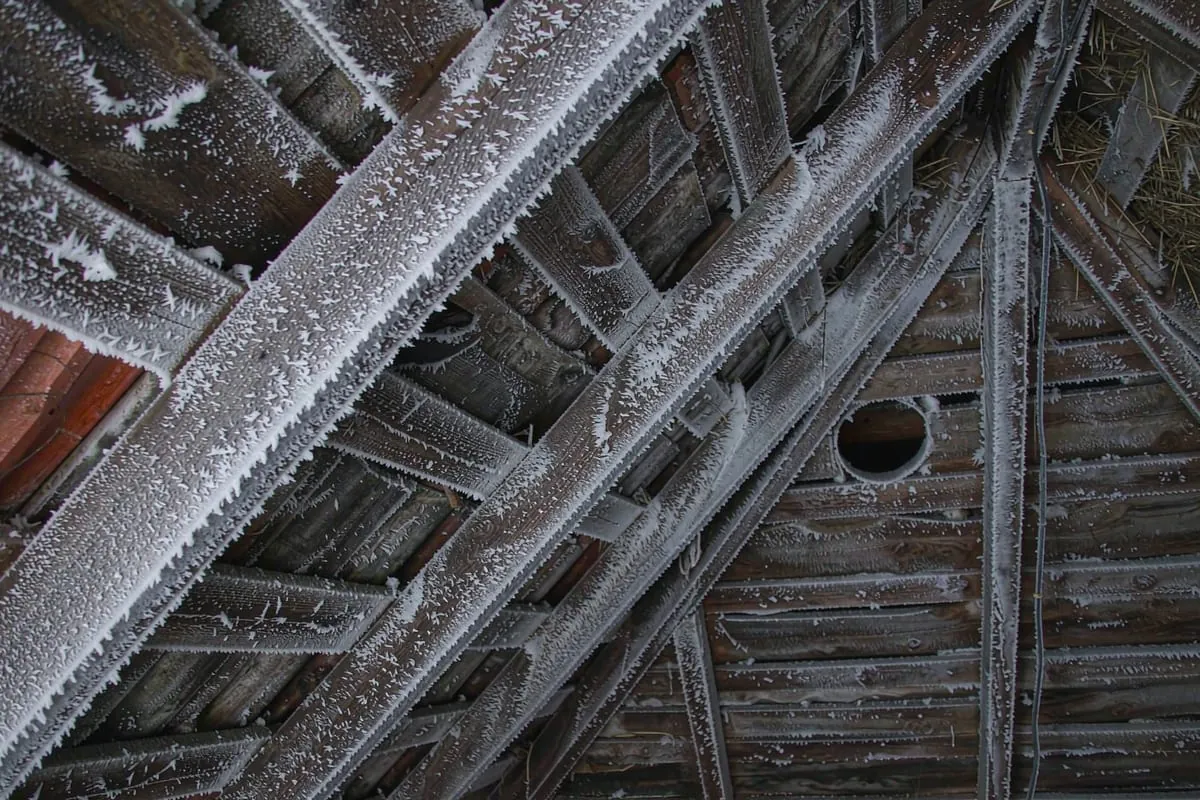
Any air that reaches the sheathing condenses on it, and at 20°F the condensate freezes rather than runs — which is why the evidence is frost on the deck rather than a damp ceiling.
Example 2 — a humid house with a warmer deck
Inputs: 70°F indoor, 60% humidity, deck at 50°F.
- Dew point
- 55.5°F
- Margin
- 5.5°F
- Verdict
- Marginal
The deck is warmer than in the first example and the margin is still smaller, because the humidity did more than the temperature. This is the roof that is dry in a mild winter and wet in a cold snap.
Barriers, air paths and the things that keep the deck dry
The dew point check says the surface is cold enough to condense. Whether it ever sees the moisture is decided by three layers above it.
The vapour barrier
A continuous vapour retarder on the warm side of the insulation slows diffusion into the assembly. It does nothing about air movement, which carries far more water than diffusion does.
Where the barrier is interrupted — at a hatch, a recessed light or a penetration — the interruption matters more than the material's perm rating.
Air leakage
Warm air leaving the rooms carries its moisture with it and deposits it on the first cold surface it meets. That is the mechanism behind most roof-deck condensation, and sealing the ceiling is the measure that addresses it.
The attic bypass sealing estimate prices that work by the length of joint, and it is usually the cheapest way to dry a roof out.
Ventilation
Ventilation removes the moisture that gets past the barrier and the ceiling, and keeps the sheathing closer to the outdoor temperature. A vented roof with a leaking ceiling still condenses; a sealed one with poor ventilation condenses less but dries more slowly.
The roof vent calculation sizes the free area.
The vent channel calculation checks the clearance above the insulation that keeps the path open.
Thermal bridges and cold spots
Condensation finds the coldest spot, which is often a rafter end, a steel fixing or the corner where the insulation thins. The dew point on those surfaces is reached long before it is on the field of the ceiling.
That is why a roof can pass an average check and still stain in one place, and why the thermal bridging calculation is worth running alongside this one.
Cathedral ceilings
A cathedral ceiling has no attic to buffer the moisture and no room for a second line of defence. The channel above the insulation is the only drying path, and if it closes the deck stays wet.
The cathedral ceiling insulation calculation is where the depth and the vent gap are reconciled.
Two neighbouring calculations set the inputs this one depends on: the roof heat loss calculator for how much heat reaches the deck, and the roof underlayment calculator for the barrier that sits under it. The calculate roof-to-floor ratio is useful when you need the roof area those figures are based on.
Limitations and assumptions
What the calculation assumes
- One air condition. The indoor air is treated as uniform, so a humid bathroom feeding a leak is averaged away.
- One surface temperature. The deck is a single figure, without cold spots at bridges and corners.
- Steady state. The check is a snapshot, not a simulation of a night's drying and wetting.
- Air reaches the deck. The verdict describes the surface, and assumes the moisture can get to it.
- The Magnus range. The coefficients are accurate over the temperatures a building sees, not at extremes.
What it does not include
- How much vapour arrives. Diffusion and air leakage rates are a separate calculation.
- Drying. Whether the assembly can dry outward or inward is not modelled.
- Material storage. Timber and insulation buffer moisture, which delays and spreads the effect.
- Mould risk. Surface humidity at the deck is not the same as the conditions mould needs.
- Summer. Reverse vapour drive in a humid climate is a different problem with a different check.
The result is a dew point and a margin for one surface at one condition. It is the first question in a moisture investigation, not the last.
How the numbers behave
Humidity moves the dew point more than temperature does over the range a house occupies. At 70°F, each 10 percentage points of humidity is worth roughly 5 to 7°F of dew point.
| Indoor humidity | Dew point at 70°F | Margin to a 20°F deck |
|---|---|---|
| 30% | 37.1°F | 17.1°F |
| 40% | 44.6°F | 24.6°F |
| 50% | 50.5°F | 30.5°F |
| 60% | 55.5°F | 35.5°F |
70°F indoor, deck at 20°F. The margin is the dew point minus 20.
The deck temperature is the other side of the same subtraction, and it has to climb a long way before the verdict changes.
| Deck temperature | Margin | Verdict |
|---|---|---|
| 20°F | 24.6°F | Condensation likely |
| 30°F | 14.6°F | Condensation likely |
| 40°F | 4.6°F | Marginal |
| 50°F | −5.4°F | No condensation |
| 60°F | −15.4°F | No condensation |
70°F at 40% humidity, dew point 44.6°F. The deck has to be within about 5°F of the dew point before the verdict turns.
The shape of both tables is the same: a linear subtraction on top of a logarithmic dew point. That is why the humidity column curves and the temperature column does not.
Frequently asked questions
Because insulation slows heat, it does not stop air. The sheathing sits on the cold side of the insulation, close to the outdoor temperature, while the air inside stays warm and humid. The gap between the two is what the dew point check measures.
Thirty to forty per cent suits most houses in a cold climate: high enough for comfort, low enough that the dew point stays well below the deck. Above 50% in winter the margin shrinks quickly, and a humidifier set too high can do more damage to the roof than it does good to the occupants.
It slows vapour diffusion, which is a small part of the problem. Most moisture reaches the deck on air that leaks through the ceiling, and a barrier with a hole in it does very little. Sealing the ceiling and the barrier together is what works.
Yes, it is the same condensation at a deck below freezing. The water vapour skips the liquid stage and deposits as ice, which is why the evidence is white crystals on the deck rather than a damp patch, and why it can look harmless until it thaws.
The outdoor air temperature is a fair proxy on a vented roof, and it is what most people have. A surface reading is better: on a clear night the sheathing radiates to the sky and can sit a few degrees below the air, which is exactly when a marginal roof starts to condense.
It helps dry the assembly and keeps the deck closer to outdoor conditions, but it does not stop warm air leaking out of the house. Where the ceiling is leaking, ventilation removes some of the moisture and the rest condenses. Sealing comes first and venting second.
Yes. A sealed ceiling with a vapour barrier on the wrong side, or with foam against the sheathing and no vent path, can trap moisture that would otherwise have dried. That is a design question about the assembly rather than a dew point one, and it is why the layers have to be specified together.
The physics is identical: any surface below the dew point collects water, whether it is glass at 35°F or sheathing at 20°F. The difference is that a window is visible and dries, while a roof deck is hidden and stays wet.
Where these numbers come from
The dew point comes from the Magnus formula, which relates saturation vapour pressure to temperature. The margin is the dew point minus the deck temperature, and the verdict is read off that margin.
No indoor humidity or deck temperature is asserted here, because both describe a particular house on a particular night.
- The formula and its coefficients. Dew point — the Magnus formula and its coefficient sets lists 17.27 and 237.7 among the common sets, valid for 0°C to 60°C with an error of about 0.4°C, which is the pair this page uses.
- Why air leakage dominates. Building Science Corporation — BSI-046 makes the point for the roof: an airtight ceiling matters more than insulation level, and ventilation is the third layer that flushes what still gets through.
- The indoor humidity. A hygrometer reading, or the 30 to 40% range that suits a heated house in winter.
- The deck temperature. Outdoor air as a proxy, or an infrared surface reading where one is available.
Keeping the moisture out?
The barrier and the air sealing decide whether the deck ever sees it.