
Roofing Delivery Weight Calculator
Turn the material quantity into delivered weight and pallet count, so you know how it arrives and whether it can be lifted.
Quick answer: 16 squares of architectural shingle at 400 lb each is 6,400 lb — 3.2 tons or 2,903 kg — arriving as 3 pallets at 2,200 lb capacity. The same roof in tile is 15,200 lb and 7 pallets, and none of it can be carried up by hand.
- Weight in pounds, tons and kilograms
- Pallet count rounded up
- Weight per square is yours
Delivery weight inputs and results
Weight per square and pallet capacity both come from the product and the supplier.
- Roof area (squares)
- Weight per square (lb)
- Pallet capacity (lb)
Material weight only; pallets and packaging add a small amount that is not modelled.
Show calculation
What a roofing delivery actually weighs
Sixteen squares of architectural shingle weighs about 3.5 to 4 tons. The same sixteen squares in clay tile weighs 6 to 9 tons. Same roof, same area, and one of those arrives on a boom truck while the other needs a crane and a second delivery.
Weight is what decides how material reaches the roof, whether a driveway survives it, and how many pallets you are paying to have lifted. The calculator turns your order into pounds, tons, kilograms and pallet count — but only if the weight per square you enter is right, which is the figure most people guess.
| Covering | lb per square | 16 squares |
|---|---|---|
| Corrugated or exposed-fix metal | 60 – 120 | 1,000 – 1,900 lb |
| Standing-seam metal | 100 – 150 | 1,600 – 2,400 lb |
| 3-tab asphalt shingle | 190 – 240 | 3,000 – 3,800 lb |
| Architectural (laminated) shingle | 220 – 280 | 3,500 – 4,500 lb |
| Impact-resistant laminated shingle | 250 – 320 | 4,000 – 5,100 lb |
| Cedar shake | 200 – 350 | 3,200 – 5,600 lb |
| Synthetic slate or shake | 250 – 450 | 4,000 – 7,200 lb |
| Clay or concrete tile | 750 – 1,100 | 12,000 – 17,600 lb |
| Natural slate | 800 – 1,500 | 12,800 – 24,000 lb |
Typical published product weights. The data sheet for the product you are buying governs — the range inside one material is often wider than the gap between two.
What this calculator works out
The material quantity you ordered has a weight, and that weight decides how it is delivered and whether it can be handled on site. This page converts squares into pounds, tons and kilograms, and into the pallet count the supplier will actually ship.
Material arrives on whole pallets, so the count matters as much as the weight. A part pallet costs the same to move as a full one, which is why the calculator rounds up and then reports how much of the last pallet is empty.
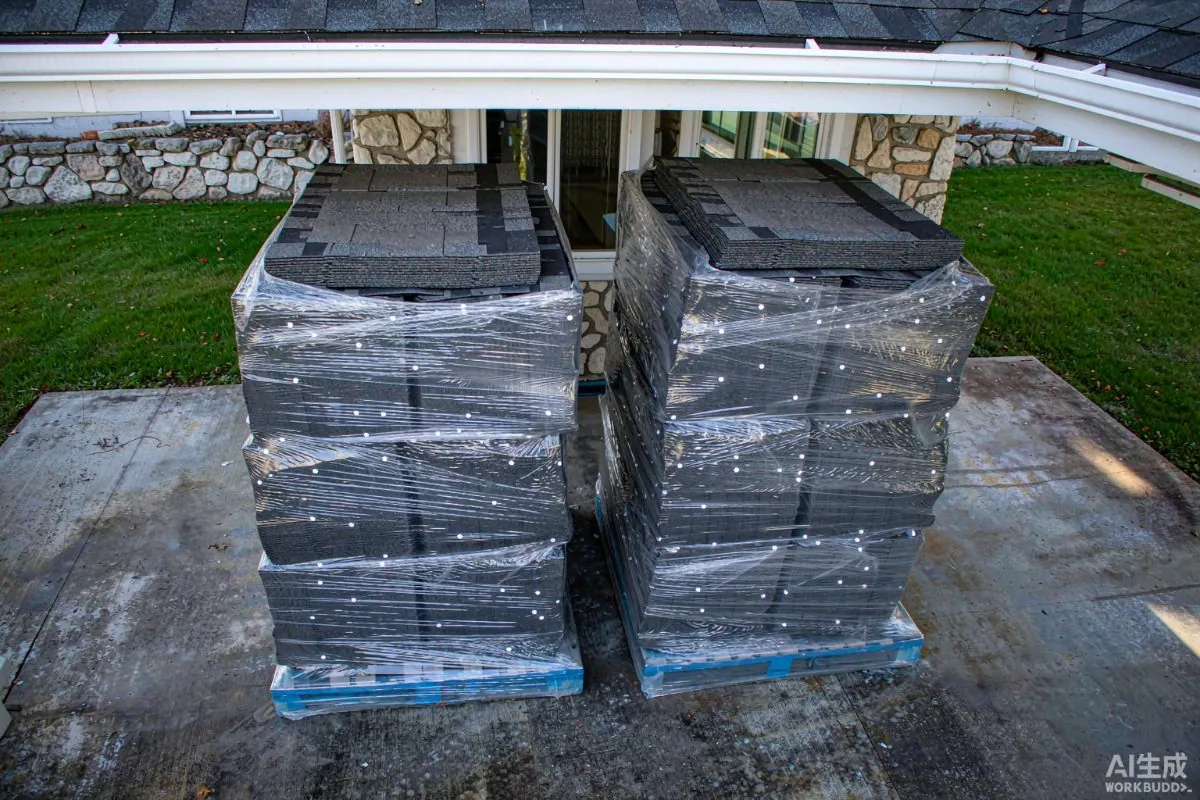
Inputs and results explained
Three inputs, five outputs. Each input has a limit built into the calculator, and going outside it returns a message rather than a wrong answer.
| Input | What to enter | Limits |
|---|---|---|
| Roof area (squares) | The squares you are buying, including waste. From the material takeoff, not the footprint of the house | 0.1 to 5,000 |
| Weight per square (lb) | From the product data sheet. Use the table above if you have no sheet yet | 1 to 5,000 |
| Pallet capacity (lb) | The load your supplier builds, or the limit your site can lift. 2,200 lb is a common default | 1 to 20,000 |
| Result | What it means | Unit |
|---|---|---|
| Delivered weight | Squares multiplied by weight per square | lb |
| Tons | The same weight in US short tons (2,000 lb) | tons |
| Kilograms | The same weight in kilograms, for suppliers who quote in metric | kg |
| Pallets | The number of whole pallets, rounded up | count |
| Pallet fill | How full the last pallet is — the spare capacity you are already paying to move | % |
How to use the Roofing Delivery Weight Calculator
- Enter the squares you are buying, including the waste allowance. If the takeoff says 14.6 squares and you are ordering 16, enter 16 — you are weighing what arrives, not what the roof needs.
- Enter the weight per square from the product data. If the sheet gives pounds per bundle, multiply by the bundles per square, which is usually three.
- Enter the pallet capacity from your supplier. If they have not said, 2,200 lb is a realistic default for shingles.
- Read the pallet fill percentage. At 97% the order is one square away from needing another pallet; at 60% you are moving a lot of empty air.
- Check the weight against your lifting plan before you confirm the delivery slot. The next section explains what the number means in practice.
If the roof is measured in square feet rather than squares, convert it first — the roofing square calculator does that, and one square is 100 sq ft of finished roof surface.
What to enter for weight per square
This is the input that decides the answer, and it is the one suppliers rarely put in front of you. There are three places to find it, in order of reliability.
1. The product data sheet. Most manufacturers publish a weight per bundle or per square. It is the only figure that reflects the product you are actually buying — two architectural shingles from different brands can differ by 40 lb per square.
2. Bundles per square × bundle weight. Asphalt shingles cover about 33.3 sq ft per bundle, so three bundles make a square. If the bundle weighs 80 lb, the square weighs 240 lb. This is the same arithmetic the data sheet uses.
3. A published range. Use the table at the top of this page and take the middle of the band, then check the delivered weight against what your supplier quotes. If they disagree by more than about 10%, ask which product they are pricing.
| Bundle weight | Bundles per square | lb per square | Typical product |
|---|---|---|---|
| 60 – 70 lb | 3 | 180 – 210 | Light 3-tab |
| 70 – 80 lb | 3 | 210 – 240 | Standard 3-tab |
| 80 – 95 lb | 3 | 240 – 285 | Architectural laminated |
| 95 – 110 lb | 3 | 285 – 330 | Heavyweight or impact-rated |
How the material actually ships
Pallet capacity is not a single industry number. It is whatever the supplier builds, limited by what the truck and the forklift can handle. Three constraints usually decide it, and the smallest one wins.
| Material | Typical pallet | What limits it |
|---|---|---|
| Asphalt shingle | 2,000 – 3,000 lb (42–48 bundles) | Forklift capacity at the yard and on site |
| Clay or concrete tile | 1,500 – 2,500 lb | Breakage and banding, not weight alone |
| Standing-seam metal | 500 – 1,500 lb per bundle | Panel length and handling, so bundles are long and light |
| Slate | 1,500 – 2,500 lb per crate | Crate strength and edge protection |
Indicative supplier practice. Your supplier’s pallet card and the lift capacity on site govern.
The pallet count also decides the delivery itself. Two pallets fit a flatbed with a tail lift; three or more usually means a boom or a crane, and that is a different booking with a different lead time. If the count surprises you, the cost factor and accessibility calculator prices what the access does to the job.
The delivery charge itself belongs in the price you quote, which is what the roofing bid calculator builds from cost, overhead and target margin.
Formula and calculation logic
Five lines of arithmetic. Only the pallet count involves a rounding decision.
| Step | Formula | What it produces |
|---|---|---|
| 1 | weight = squares × weight per square | Delivered weight in pounds |
| 2 | tons = weight ÷ 2,000 | US short tons |
| 3 | kilograms = weight × 0.453592 | Metric equivalent |
| 4 | pallets = ceiling(weight ÷ pallet capacity) | Whole pallets |
| 5 | fill = weight ÷ (pallets × capacity) | How full the last pallet is |
Variables. squares is the area ordered in units of 100 sq ft. weight per square is in pounds. pallet capacity is in pounds.
Unit explanation. One square is 100 sq ft of finished roof, and a US ton is 2,000 lb — not the 2,240 lb imperial ton. The kilogram factor is exact at 0.453592 lb per kilogram. All three are conversions, not judgements, so the only place the calculator makes a choice is step 4.
Why the pallet count rounds up. Material ships on whole pallets. You cannot order two-thirds of one, and a part pallet still costs a full one to move. The ceiling function is applied with a small tolerance so that a weight which divides exactly does not round up to an extra pallet through floating-point error.
Rounding. Weight, tons and kilograms are carried at full precision and rounded for display. The pallet count is the only whole number in the chain, which is why the fill percentage is worth reading: it tells you how much of that rounded-up pallet you are paying for.
What the weight means on site
Six thousand four hundred pounds is not a ladder job. It is three pallets that need a boom, a conveyor or a crane to reach the roof, and that changes the delivery cost and the day’s programme.
The reason is not the total weight — it is the weight of any single lift. The NIOSH lifting equation, the standard method for assessing manual handling, uses a load constant of 23 kg (about 51 lb) for an ideal lift, and reduces it further for reach, twist and repetition. A 6,400 lb delivery is roughly 125 ideal lifts even before the awkward shapes, the pitch and the height are counted.
So the practical question is not “how heavy is it” but “how does it get up there”. Three options cover most jobs: a boom truck with a crane, which sets pallets directly on the roof; a conveyor, which is slower but cheaper for a small load; and manual carrying, which is only realistic for a handful of bundles or a metal bundle.
| Delivered weight | Realistic method | What it changes |
|---|---|---|
| Under 500 lb | Manual carry | Nothing — a two-person job |
| 500 – 2,000 lb | Conveyor or roof-loaded boom | Half a day of handling, one extra operative |
| 2,000 – 8,000 lb | Boom truck, pallets set on the roof | Vehicle access, overhead lines, a booked slot |
| Over 8,000 lb | Crane, or split deliveries | Structural check on the deck, a lift plan, permits |
Indicative thresholds. Site access, roof structure and local rules decide the actual method.
Weight also lands on the building. A pallet set on a roof concentrates several thousand pounds into a small footprint, and that is a point load on the deck rather than a distributed one. Heavy coverings are usually craned to the ground and distributed in smaller lifts for exactly this reason, and the roof weight calculator checks the finished load against the structure rather than the delivery.
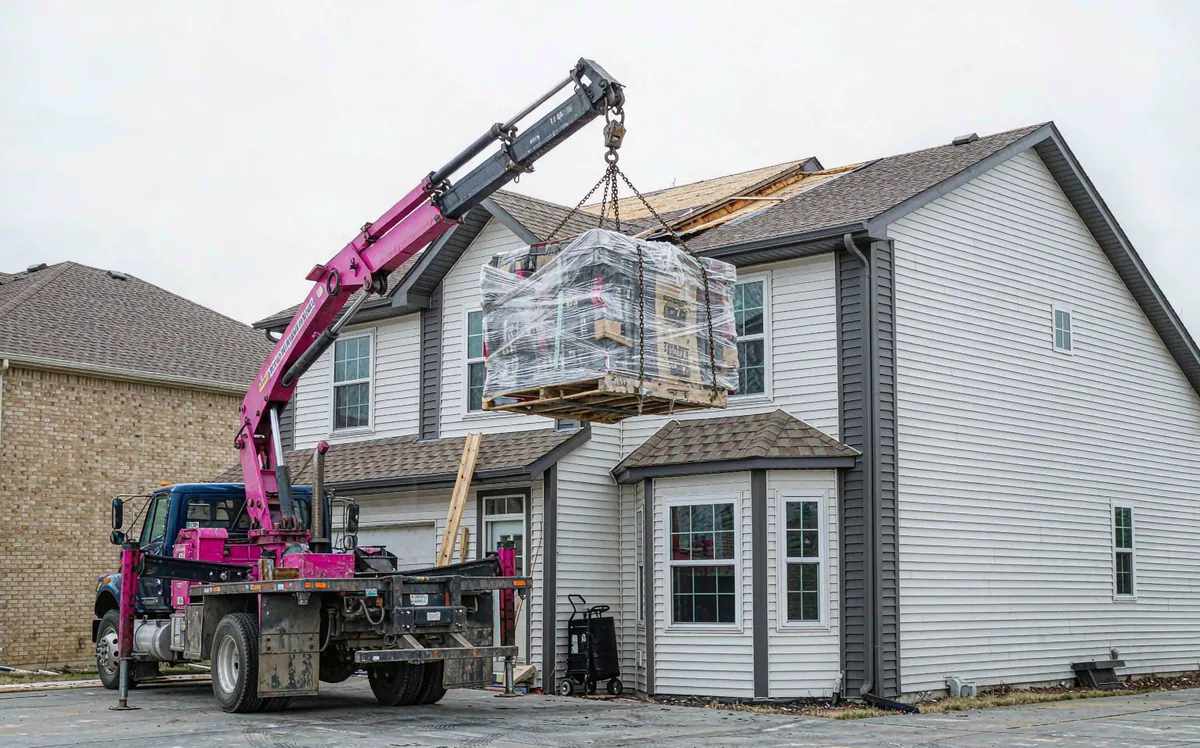
Worked examples
Three coverings on the same 16-square roof. The arithmetic is identical; only the weight per square changes.
Example 1 — architectural shingle
- weight = 16 × 400 = 6,400 lb
- tons = 6,400 ÷ 2,000 = 3.20
- kilograms = 6,400 × 0.453592 = 2,903
- pallets = 6,400 ÷ 2,200 = 2.91, rounded up to 3
- fill = 6,400 ÷ 6,600 = 97%
Three pallets with almost no spare on the third. Adding two more squares would push the order to four pallets — worth knowing before you add waste.
Example 2 — clay tile
- weight = 16 × 950 = 15,200 lb
- tons = 15,200 ÷ 2,000 = 7.60
- kilograms = 15,200 × 0.453592 = 6,895
- pallets = 15,200 ÷ 2,200 = 6.91, rounded up to 7
- fill = 15,200 ÷ 15,400 = 99%
More than double the weight for the same area, and seven pallets instead of three. At this weight the delivery method is decided for you: no one is carrying it.
Example 3 — standing-seam metal
- weight = 16 × 130 = 2,080 lb
- tons = 2,080 ÷ 2,000 = 1.04
- kilograms = 2,080 × 0.453592 = 943
- pallets = 2,080 ÷ 2,200 = 0.95, rounded up to 1
- fill = 2,080 ÷ 2,200 = 95%
One pallet, just over a ton. The constraint with metal is panel length and handling, not weight — which is why the pallet count is low and the delivery is still awkward.
The weight going out
The calculator weighs what arrives. The tear-off weighs more, and it is the half of the job that gets underestimated.
Old asphalt shingle runs about 200 to 280 lb per square once it is stripped, and that is per layer. A roof with two layers is two of those, plus the underlayment, nails and whatever flashing comes off with it. Sixteen squares of two-layer tear-off is comfortably 7,000 to 9,000 lb of debris — heavier than the new roof going on.
Debris is also bulkier than it is heavy, which is why disposal is priced by volume rather than weight. A container that is full at four tons may still have room by weight, and a container that is legally loaded may be nowhere near full. The dumpster size calculator works in the other direction, from strip volume to container count.
Limitations and assumptions
What it assumes.
- Material weight only. Pallets, banding and packaging add a small amount that is not modelled.
- Every square weighs the same. On a mixed roof — shingle field with a tile porch — run the two areas separately.
- Accessories are excluded: ridge vent, hip and ridge cap, starter strip, underlayment and fasteners all add weight, and together they can be 5 to 10% of the total.
What it does not include.
- Vehicle and axle limits, which decide whether the order fits one truck.
- The capacity of the roof structure under a point load.
- Tear-off weight, which is covered separately above.
- Any allowance for wet material. Shingles stored outside in the rain gain weight, and it is not a small amount.
Treat the result as a handling and logistics figure. It is accurate for what it models and silent about everything else, which is why the exclusions above are worth pricing before the delivery is booked.
For the material spend that sits underneath the weight, the roof replacement cost calculator prices the covering itself by square and by material.
Frequently asked questions
About 190 to 240 lb for 3-tab and 220 to 280 lb for architectural shingle. A square is three bundles of 33.3 sq ft each, so the figure follows from the bundle weight: 80 lb bundles give a 240 lb square. Heavier products in the same category can add 40 lb or more.
Because it decides how the material reaches the roof. Under 500 lb is a manual carry; a few tons needs a boom or a conveyor; over eight tons usually needs a crane or split deliveries. The weight is also the load on the driveway and the point load on the deck.
At 240 lb per square and 2,200 lb per pallet, 20 squares is 4,800 lb and 3 pallets (2.18 rounded up). At 950 lb per square for tile it is 19,000 lb and 9 pallets. The count follows the covering, not the area.
Material ships on whole pallets and a part pallet costs a full one to move. Rounding down would understate the handling and the delivery charge. The pallet fill percentage shows how much of that rounded-up pallet you are actually using.
Yes — enter the squares you are buying, not the squares the roof measures. Waste material is delivered, handled and lifted like the rest, so it carries the same cost. A 10% waste allowance on a 16-square roof is 1.6 extra squares and roughly 380 lb.
It affects the delivery and handling, not the material. Three pallets instead of two can mean a boom instead of a tail lift, which is a different booking. The material cost is the same; the cost of getting it onto the roof is not.
Not modelled. Pallets, banding and wrap add a small percentage — typically well under 5% — and they are removed on site, so they affect the delivery weight but not the roof load. For a handling plan, add a few per cent; for a structural check, ignore them.
Because suppliers, crane operators and lifting equipment are often rated in metric. A crane chart in kilograms and a delivery note in pounds is how capacity mistakes happen. Both figures come from the same weight, converted at 0.453592.
Often, yes — a rigid boom truck carries several tons without trouble. The constraint is usually axle and bridge limits rather than total capacity, and those are set by the vehicle and the route. Ask the supplier what their truck is plated for; it is a one-question check that prevents a split delivery.
The 400 lb per square and 2,200 lb per pallet defaults are realistic for architectural shingle. The 16-square area is illustrative. Replace all three with your own figures — the answer is only as good as the weight per square you enter.
Where these numbers come from
Two kinds of information sit on this page, and they are kept separate: the arithmetic the calculator runs, and the handling guidance the weight feeds into.
From the calculator. The five steps in the calculation section were read from the page’s own code. The conversion factors are exact: 2,000 lb to a US short ton, 0.453592 lb to a kilogram.
From public sources.
- National Institute for Occupational Safety and Health, Applications Manual for the Revised NIOSH Lifting Equation — the standard method for assessing manual lifting, and the source of the 23 kg (51 lb) load constant used in the on-site section.
- Asphalt Roofing Manufacturers Association, ARMA technical resources — asphalt roofing systems, components and installation practice behind the shingle weights discussed here.
Material weights. The per-square figures are typical published product weights. They are not output from this calculator, and the manufacturer’s data sheet for the product you are buying takes precedence — two architectural shingles can differ by 40 lb per square.
Next: size the container
The dumpster calculator turns the strip into volume and container count.