
Cool Roof Calculator
A reflective roof sends sunlight back instead of letting it through the deck. Work out what that is worth: enter the reflectance you are moving from and to, the sun the roof sees, and the R-value above the ceiling, and the page returns the heat gain avoided, the kWh and the money.
Quick answer: a 1,500 sq ft roof moving from 0.10 to 0.75 reflectance in a climate delivering 250 BTU/ft²/h over 1,000 cooling hours avoids 1,974,644 BTU — about 579 kWh and $87 a year at $0.15, on an R-30 ceiling. The same roof over R-10 saves $247: the insulation was already stopping most of the heat, so a reflective surface has less left to work on.
- Reflectance, sun and R-value
- Formula shown step by step
- Screening figure, not a code check
Inputs and results
Use the 3-year aged reflectance from the product listing, not the initial laboratory figure — a white roof that has weathered is not the roof on the box.
The saving is heat that no longer reaches the space, removed at the efficiency implied by your electricity rate. It is not the sunlight reflected off the roof.
Show calculation
A cool roof works on the sun, not on the insulation
A dark roof absorbs most of the sunlight that lands on it and runs hot; a reflective one sends a large share back and stays cooler. The saving is the heat that no longer has to be removed by the cooling plant, which is why the roof assembly sits in the middle of the calculation rather than the colour alone.
The page takes the change in reflectance, turns it into a surface temperature difference, pushes that difference through the roof's R-value to get a heat flux, and converts the flux into kWh and money. Each step is visible in the formula panel, so any one of them can be checked against the others.
Reflectance on its own does not decide the answer. The same white membrane over R-10 avoids several times the heat it does over R-30, because a well-insulated assembly was already resisting most of the gain before the colour changed.

The seven inputs and three results
Two fields describe the change in colour, two describe the sun, one describes the assembly and one describes what electricity costs where the building is.
| Input | Unit | What it is | How to obtain it |
|---|---|---|---|
| Roof area | sq ft | The area of roof above the conditioned space | Plan dimensions, or the sloped area if the roof is pitched |
| Solar reflectance, new roof | — | Share of sunlight the new surface reflects | The 3-year aged value in the product listing |
| Solar reflectance, existing roof | — | Share the surface reflects now | The same listing, or a reading from the surface if it is coated |
| Average irradiance | BTU/ft²/h | Sun landing on the roof during cooling hours | Local solar data divided by the hours in the next field |
| Cooling hours | h | Sunlit hours in the cooling season | A design assumption — 600 to 900 short, 1,200 to 1,600 long |
| Roof assembly R-value | h·ft²·°F/BTU | Insulation and deck between membrane and ceiling | The drawings, or the insulation specification |
| Electricity rate | $ per kWh | What the cooling plant pays per unit | The bill, or the tariff that applies |
All seven are entered on the left of the calculator, and the result updates as you type.
The three results
One is energy at the roof, one is energy at the meter, and one is money.
| Result | Unit | What it means |
|---|---|---|
| Heat gain avoided | BTU | The solar heat that no longer crosses the roof over the cooling season. |
| Electricity avoided | kWh | The same energy expressed as cooling electricity, at 3,412 BTU per kWh. |
| Annual cooling saving | $ | The kWh priced at your rate — what the cooling plant no longer spends. |
The kWh figure assumes the cooling plant removes the heat at 100% efficiency, so it is the floor of the electricity story rather than a forecast of the bill.
Choosing the reflectance, the hours and the R-value
The new reflectance
Take the 3-year aged value from the product listing, not the initial figure. The gap is not cosmetic: a white membrane that tests near 0.85 when new is typically rated around 0.75 after three years of dirt and weathering, and that tenth is worth roughly a sixth of the saving.
Aged values that hold up in practice: white TPO or PVC 0.75 to 0.85, white elastomeric coating 0.70 to 0.80, cool-coloured metal or shingle 0.25 to 0.45, granulated dark shingle 0.10 to 0.20, black EPDM 0.05.
The reflectance it replaces
The saving is a difference, not an absolute. A black membrane at 0.05 against a white one at 0.80 is a change of 0.75; replacing mill-finish metal that already reflects about 0.55 gains far less than the colour change suggests.
If the roof is being recoated rather than replaced, use the reflectance of the surface as it stands after cleaning. A chalked coating reads well below its original rating, and coating over it recovers more than the numbers imply.
Irradiance and cooling hours
Irradiance is the sunlight landing on the roof, averaged across the hours in the next field. Peak summer noon is around 300 BTU/ft²/h; a cooling-season average usually falls between 150 and 250, because mornings, afternoons and cloud pull it down.
Cooling hours are the hours the roof is in sun during the cooling season, not equivalent full-load hours. Mixing the two is the most common way to get a figure that looks plausible and is wrong by a factor of two.
The R-value
Enter the insulation and deck between the membrane and the ceiling, without the surface films; the calculator adds 0.86 for those. A code-minimum ceiling is R-30 to R-60 depending on climate zone, while an uninsulated metal warehouse roof may be R-2.
Where the roof is the ceiling, as in an open warehouse, the R-value is the roof build-up alone. That is why those buildings gain so much more from a reflective surface than a house does, and why the roof insulation amount matters as much as the membrane.
Common measuring mistakes
- Initial reflectance used as if it were aged. The first summer is not the tenth, and the saving is calculated over years.
- Comparing against a roof that was never dark. Bare metal and weathered grey membranes already reflect a useful share.
- Irradiance averaged over the whole year. The saving only accrues while the cooling plant is running.
- R-value taken as the insulation only. The deck, the ceiling and the films all sit in the same path.
- Heating-season penalty ignored. In a cold climate it can take back a visible share of the cooling saving.
How to use the Cool Roof Calculator
Seven fields, and the number to watch is the saving rather than either energy figure on its own.
- Enter the roof area. Only the area over conditioned space counts; a garage roof does not.
- Enter the new reflectance. The 3-year aged value from the product data.
- Enter the existing reflectance. What is on the roof now, or what it will be after cleaning.
- Enter the irradiance. Local solar exposure divided by the cooling hours you intend to use.
- Enter the cooling hours. Sunlit hours in the cooling season.
- Enter the R-value. Insulation and deck, without the films.
- Enter the electricity rate. From the bill, including any demand component you can attribute.
If the saving looks too good, the cause is usually the hours field or the R-value. A reflective roof on a well-insulated ceiling is a modest number, and a large one usually means an uninsulated assembly or a cooling season counted twice.
How the saving is worked out
heat flux avoided = surface rise ÷ (R-value + 0.86)
BTU avoided = flux × area × hours
kWh = BTU ÷ 3,412
saving = kWh × rate
Variables
- new and old reflectance
- The share of sunlight each surface sends back, as a decimal from 0 to 1.
- irradiance
- Solar power landing on the roof during cooling hours, in BTU/ft²/h.
- hours
- Sunlit hours in the cooling season.
- R-value
- Thermal resistance of the insulation and deck, in h·ft²·°F/BTU.
- area
- Roof area over conditioned space, in square feet.
- rate
- Electricity price in dollars per kWh.
- 4.0 and 0.86
- The outdoor surface coefficient and the two surface films, both fixed constants explained below.
Unit explanation
Irradiance multiplied by a reflectance difference gives a number in BTU/ft²/h, which is a heat flux rather than a temperature. Dividing by 4.0 BTU/h·ft²·°F converts it into a temperature difference, in °F, which is the sol-air rise at the surface.
Dividing that temperature by an R-value in h·ft²·°F/BTU returns BTU/ft²/h again, this time the flux that actually crosses the assembly. Multiplying by area in ft² and hours leaves BTU, and 3,412 BTU is one kWh.
Why the surface temperature comes first
Sunlight does not heat the room directly; it heats the surface, and the surface then drives heat through the assembly. The 4.0 constant is the outdoor surface coefficient, which bundles convection and radiation into one number for a horizontal surface in summer.
It can be checked against measurement. A 0.60 reflectance difference at peak sun of about 300 BTU/ft²/h gives 45°F, and the Heat Island Group measures roughly 55°F between a white roof at 0.80 and a grey one at 0.20 — the same order, with the difference coming from wind and surface temperature.
Why the R-value divides
Heat crossing the assembly is proportional to the temperature difference and inversely proportional to the resistance. Double the R-value and the same surface rise produces half the flux, which is why the saving falls away so quickly on a well-insulated roof.
The 0.86 in the denominator is the interior and exterior film resistance, about 0.61 and 0.25. Leaving them out overstates the flux slightly, and they matter most on a thin assembly where they are a large share of the total.
Numerical example
A 1,500 sq ft roof moving from 0.10 to 0.75, at 250 BTU/ft²/h over 1,000 cooling hours, on R-30 at $0.15:
- Surface rise
- (0.75 − 0.10) × 250 ÷ 4.0 = 40.63°F
- Heat flux avoided
- 40.63 ÷ (30 + 0.86) = 1.316 BTU/ft²/h
- BTU avoided
- 1.316 × 1,500 × 1,000 = 1,974,644 BTU
- Electricity avoided
- 1,974,644 ÷ 3,412 = 578.7 kWh
- Saving
- 578.7 × $0.15 = $87
The same roof at R-10 gives a flux of 3.741 and $247; at R-2 it gives 14.2 and $937. The reflectance did not change in any of those three cases.
Result interpretation
The saving is the cooling energy that no longer has to be bought, valued at the rate you entered. It is a screening figure for deciding whether a reflective surface is worth specifying, not a prediction of next August's bill.
A useful sanity check is to compare it with what the building spends on cooling. A saving above roughly a fifth of the annual cooling cost on an insulated roof usually means the hours are too high or the R-value too low, and the roof energy savings calculation is the other half of the same question.
Worked examples: an insulated house and an older ceiling
Example 1 — a code-minimum ceiling
Inputs: 1,500 sq ft, reflectance 0.75 against 0.10, 250 BTU/ft²/h, 1,000 hours, R-30, $0.15.
- Surface rise
- 0.65 × 250 ÷ 4.0 = 40.63°F
- Flux avoided
- 40.63 ÷ 30.86 = 1.316 BTU/ft²/h
- Heat gain avoided
- 1,974,644 BTU
- Electricity avoided
- 578.7 kWh
- Annual saving
- $87
On a well-insulated ceiling the roof is not where the heat comes from, so the reflective surface has little to work on. That is the honest answer for most modern houses, and it is why the payback on a cool roof is longer there than the marketing suggests.
Example 2 — an older ceiling at R-13
Inputs: 2,000 sq ft, reflectance 0.70 against 0.12, 230 BTU/ft²/h, 1,100 hours, R-13, $0.18.
- Surface rise
- 0.58 × 230 ÷ 4.0 = 33.35°F
- Flux avoided
- 33.35 ÷ 13.86 = 2.406 BTU/ft²/h
- Heat gain avoided
- 5,293,651 BTU
- Electricity avoided
- 1,551.5 kWh
- Annual saving
- $279
Twice the area and a worse ceiling, and the saving triples. The lesson is not that the coating got better; it is that a reflective surface pays where the assembly is weak, which is the same conclusion the metal roof colour and heat calculation reaches from the surface temperature side.
What makes a roof cool, and what erodes it
Reflectance is a property of the surface, and the surface is the part that ages. What the product is made of matters less than how it behaves after three summers.
Coatings and single-ply membranes
A white elastomeric coating over an existing dark membrane is the cheapest route to a cool roof, because it leaves the waterproofing in place. A white TPO or PVC membrane is the alternative when the roof is being replaced, and both start near 0.80 before weathering.
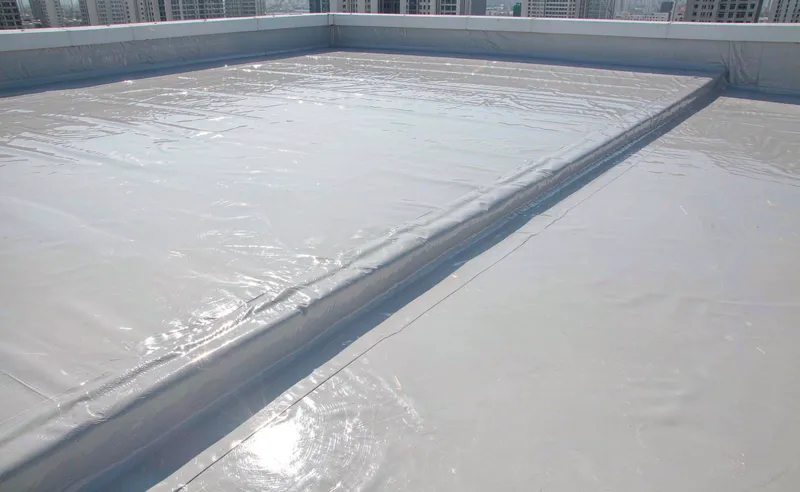
The coating thickness matters: a thin coat over a dark surface reads high when new and drops quickly as it wears, while a properly built-up coat holds its reflectance for longer.
Cool-coloured metal, shingle and tile
On a pitched roof a white surface is rarely acceptable, and it does not have to be. Cool-coloured products reflect strongly in the near-infrared, which is about half of the sun's energy and none of its visible colour, so a dark grey or terracotta roof can reach 0.30 to 0.45 without looking different.
That is still well below a white membrane, and the metal roof colour and heat calculation is the place to see what a given absorptance does to surface temperature.
Ageing, dirt and cleaning
Reflectance falls fastest in the first year and then levels off, which is why the rating standard uses a 3-year aged value rather than an initial one. Dirt, exhaust and biological growth all sit on the surface and absorb.
Cleaning recovers part of the loss but not all of it, and a roof that is cleaned every few years keeps a higher average reflectance than one that is not — a maintenance point worth making when the specification is written.
Emissivity and SRI
Reflectance controls how much sunlight is absorbed; emissivity controls how readily the surface radiates that heat away again. A bare metal roof can reflect well and still run hot because it emits poorly, which is why the two are rated separately.
The Solar Reflectance Index combines them into one number, and it is what most codes and programmes quote. This page works from reflectance alone, so a low-emissivity product will perform slightly worse than the calculation suggests.
The heating season
A reflective roof also turns away winter sun. In a heating-dominated climate that is a real cost, though a small one: the winter sun is low, the days are short and the sky is often overcast, so the solar gain given up is a fraction of the summer gain refused.
Where heating is electric and cooling is modest, the penalty can approach the benefit. The page does not compute it, and the limitations section says so.
Where the money actually lands
The saving here is energy. On a commercial tariff with a demand charge, a cool roof also trims the summer peak, and that is often the larger line; the cool roof tax credit calculator covers the capital side if the work qualifies.
One thing a cool roof does not change is the water. Rain landing on it is neither cleaner nor dirtier than rain on a dark roof, so the rainwater collection calculation uses the same area and the same runoff coefficient.
Limitations and assumptions
What the calculation assumes
- Steady state. The surface rise is applied as a constant, so thermal mass and the afternoon lag in a heavy roof are not modelled.
- One reflectance for the whole roof. A roof with a plant screen, a darker plant area or heavy shading is treated as uniform.
- Heat crosses the assembly only. Air leakage, ducts in the roof and solar gain through windows are outside the path.
- Cooling runs whenever the sun is out. The hours field is applied to the whole season without weighting for part-load or night operation.
- 100% removal efficiency. The kWh figure assumes every BTU avoided is one BTU the plant no longer has to move.
What it does not include
- The heating penalty. Winter solar gain given up is not subtracted, which matters in a cold climate.
- Demand charges. Peak-kW savings on a commercial tariff are often larger than the energy saving and are not modelled.
- Installation cost. Neither the coating nor the membrane is priced, so there is no payback here.
- Emissivity. Only reflectance is used, so a low-emissivity surface is flattered.
- Code compliance. Whether a rating is required, and at what value, is a local question this page does not answer.
The result is a screening figure for one question: is a reflective surface worth specifying on this roof. It is not an energy model of the building, and the assembly still has to be built as assumed.
The calculator runs entirely in your browser and nothing you type is sent anywhere; our privacy policy sets out exactly what is and is not collected.
How the numbers behave
Two things drive the result, and they pull in opposite directions: a bigger reflectance change adds saving, a better ceiling removes it. At the default area, sun and rate, the R-value sweep looks like this.
| Roof assembly | Flux avoided | Electricity avoided | Annual saving |
|---|---|---|---|
| R-2 metal, no ceiling | 14.21 | 6,245 kWh | $937 |
| R-5 | 6.93 | 3,048 kWh | $457 |
| R-10 | 3.74 | 1,645 kWh | $247 |
| R-20 | 1.95 | 856 kWh | $128 |
| R-30 | 1.32 | 579 kWh | $87 |
| R-49 | 0.82 | 358 kWh | $54 |
1,500 sq ft, 0.75 against 0.10, 250 BTU/ft²/h, 1,000 hours, $0.15. Flux in BTU/ft²/h.
Doubling the R-value halves the saving, and the curve flattens at the top: the step from R-2 to R-10 is worth more than every step after it put together. That is the whole argument for insulating before coating, and the reverse of how cool roofs are usually sold.
Reflectance behaves differently — it is close to linear. Each additional tenth of reflectance change adds roughly the same saving, so a cool-coloured roof at 0.35 captures about half of what a white one at 0.75 does.
| New reflectance | Change from 0.10 | Electricity avoided | Annual saving |
|---|---|---|---|
| 0.30 | 0.20 | 178 kWh | $27 |
| 0.50 | 0.40 | 356 kWh | $53 |
| 0.65 | 0.55 | 490 kWh | $73 |
| 0.75 | 0.65 | 579 kWh | $87 |
| 0.85 | 0.75 | 668 kWh | $100 |
R-30 ceiling, everything else at the defaults. The last tenth of reflectance is worth about $13 a year on this roof.
Frequently asked questions
Because most of the sunlight never reaches the room. The surface heats up, and the assembly resists the flow: on R-30 only about one part in a hundred and twenty of the absorbed heat crosses into the space, and the rest is convected and radiated away outside. A page that prices the whole reflected share as cooling is overstating by an order of magnitude.
The 3-year aged value from the CRRC rated products directory, which lists initial and aged reflectance side by side for every listed product. Rated white membranes sit around 0.75 aged; cool-coloured metal and shingle between 0.25 and 0.45. The initial figure is a laboratory number and is not what the roof will be after two summers.
Less, and it can cost something. A reflective surface also turns away winter sun, so the cooling saving is reduced by a heating penalty that this page does not compute. In most temperate climates the summer benefit still wins, because the winter sun is low, the days are short and the sky is often overcast.
No. A cool roof reflects at the outer surface, before the heat enters the assembly; a radiant barrier reflects across an attic cavity, after the deck has already absorbed. They address different paths and can be used together, and the radiant barrier calculation covers the attic side.
It sets how much of the surface heat reaches the space. The same white membrane avoids $937 a year over an uninsulated metal roof and $87 over R-30, because the insulation was already doing the work. That is why the payback on a cool roof is shortest on old, poorly insulated buildings.
Not as well, but far better than the colour suggests. Cool-coloured products reflect in the near-infrared, which is about half of the sun's energy and none of its visible colour, so they reach 0.30 to 0.45 where an ordinary dark roof sits near 0.10. On the default roof that is roughly $27 to $53 a year rather than $87.
Most of the loss happens in the first year, which is why the rating uses a 3-year aged value rather than a 10-year one. After that it declines slowly, and periodic cleaning recovers part of what dirt took. A roof that is never cleaned settles well below its rated figure.
No. It is a steady-state screening figure for one surface, and it ignores thermal mass, air leakage, ducts, windows and the heating season. A building where the cool roof is part of a larger envelope decision needs a full model, and a commercial tariff with a demand charge needs the peak calculation as well.
Where these numbers come from
The saving is the change in absorbed sunlight, converted to a surface temperature rise, then to a heat flux through the assembly, then to kWh at 3,412 BTU each. The constants are the outdoor surface coefficient of 4.0 BTU/h·ft²·°F and 0.86 for the surface films.
No reflectance, no irradiance and no R-value is asserted by this page, because all three depend on the product, the climate and the building.
- The reflectance values. CRRC — Rated Roof Products Directory lists initial and 3-year aged solar reflectance, thermal emittance and SRI for every rated product, which is the only defensible source for the two reflectance fields.
- The physics and the temperature check. Berkeley Lab Heat Island Group — Cool Roofs sets out solar reflectance and thermal emittance, measures roughly 55°F between a white roof at 0.80 and a grey one at 0.20, and notes that the winter heating penalty is small across most of the United States.
- The irradiance and hours. Local solar data or a design weather file, divided by the hours in the cooling season. Peak horizontal irradiance in summer is close to 300 BTU/ft²/h.
- The R-value. The insulation specification and the drawings, including the deck. The films are added by the calculator.
Comparing the surface with the assembly?
The insulation decides how much of the surface saving you keep.