
Commercial Roof Cost Calculator
Price a commercial roof in parts: the field area, the perimeter and edge details, the penetrations that each need their own flashing, and the tear-off and insulation allowances that separate a recover from a replacement.
Quick answer: a 5,000 sq ft field at $6.50 is $32,500, 400 ft of edge at $8 is $3,200, and 12 penetrations at $150 is $1,800 — $37,500 in total, or $7.50 per square foot. Add a $1.50 tear-off and $1.00 of insulation in a 1.10 market and the same roof is $55,000, or $11.00 per square foot.
- Field, edge and penetrations
- Cost per square foot
- Detail share of total
Commercial roof cost calculator inputs and results
Field area is the open working area. The perimeter and the penetrations are priced apart because they are labour, not membrane. Tear-off and new insulation are per square foot of field — leave both at zero for a recover over the existing roof.
- Field area (sq ft)
- Field rate per sq ft
- Perimeter (ft)
- Edge rate per ft
- Penetrations
- Cost per penetration
- and 3 more below
Detail share shows how much of the bill is edge and penetration work; past a third, the roof is mostly detailing.
Show calculation
What the commercial roof cost calculator works out
Commercial roofs are not one quantity. The field is an area, the perimeter is a length, and every penetration is a discrete detail. Pricing them together as a single rate per square foot hides the part that usually causes the overrun — and the allowances for tear-off and insulation, which decide whether the job is a recover or a replacement.
This calculator keeps the three separate and reports what share of the total is detail work — the figure that decides whether a repair or a replacement is the better spend.
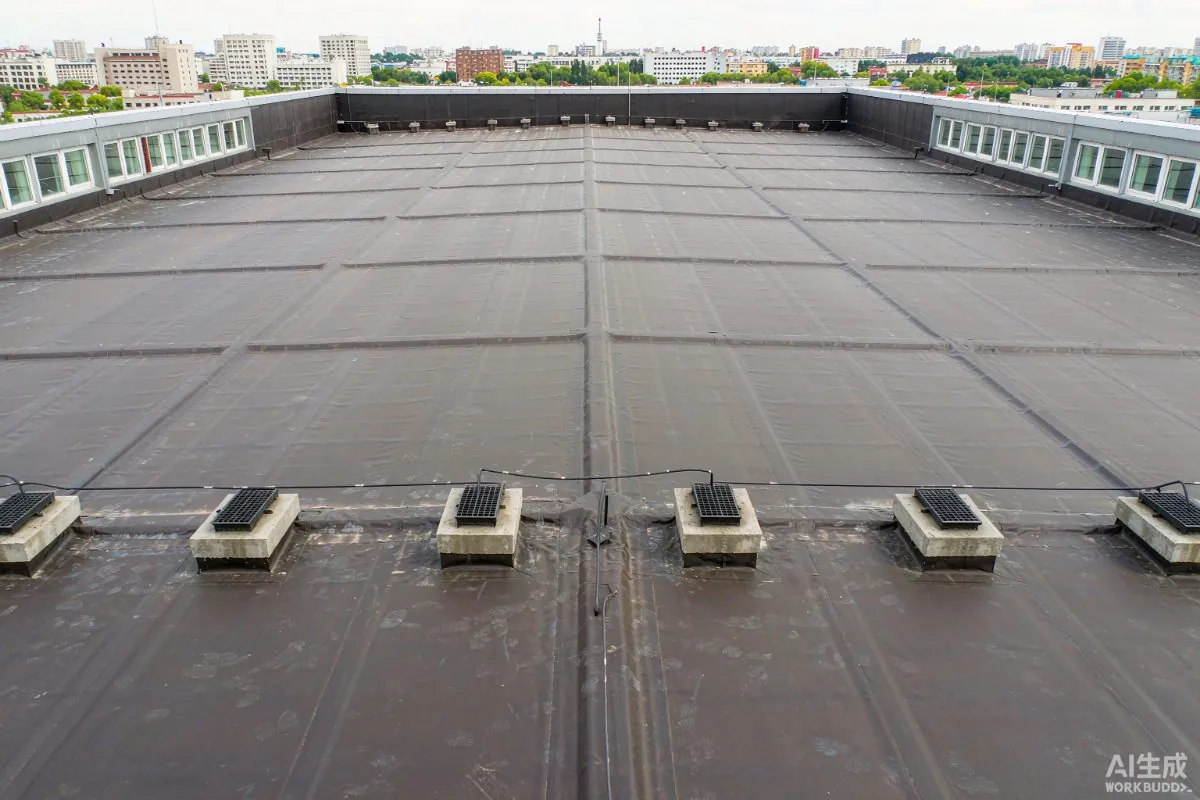
How to Measure a Commercial Roof
Three quantities go into the calculator, and each is measured a different way. None of them can be taken from the floor plan.
| What to measure | How | The usual error |
|---|---|---|
| Field area | The roof plane inside the upstands | Using the footprint, which ignores plant and set-backs |
| Perimeter | A tape along every upstand, verge and abutment | Measuring the parapet only and missing abutments |
| Penetrations | A walk of the roof, counting each unit once | Counting from drawings, which miss later additions |
| Tear-off layers | Checked at a core, not assumed from the age | Pricing one layer when there are two |
The rates are not measured at all: they come from the quotation for the system specified.
Measure the field first and the details second, because the details are what change when the field is re-measured. A roof re-outlined on a satellite image usually gains a little area and loses a few penetrations, and the second error is the more expensive one.
Where the roof is being replaced rather than recovered, the tear-off quantity is the same area as the field — but the layer count has to be established on site. Two layers cost roughly twice the disposal of one, and an old asphalt assembly may need an asbestos survey before anyone can price the removal at all.
How to Use the Commercial Roof Cost Calculator
Nine fields, entered in the order the work is measured: the field, the edges, the details, then the allowances underneath them and the market they are being priced in.
- Enter the field area and its rate. The open working area in square feet, and the installed rate per square foot for the membrane system you intend to buy.
- Enter the perimeter and the edge rate. The linear feet of parapet, termination and edge metal, and the rate per foot for detailing them.
- Count the penetrations. Vents, hatches, curbs, drains and plant, with an average cost each. A curb with a unit on it is one penetration.
- Set the tear-off and insulation allowances. A rate per square foot for a replacement, or zero for a recover. Add insulation if it is going in, and leave it at zero if not.
- Apply the region factor. Leave it at 1.00 for a national baseline, or use the local index for your market.
- Read the three results. The total, the cost per square foot under it, and the detail share — which tells you how much of the bill sits in edges and penetrations rather than in membrane.
- Check the inputs before you use it. Confirm the rate came from a quotation for this system, that the allowances are not already inside the field rate, and that the perimeter was measured rather than scaled off a plan.
The nine inputs and the results
Three quantities and three rates, plus the two allowances that decide most of the difference between a recover and a replacement, and one multiplier for the region.
| Input | Unit | What it is | How to obtain it |
|---|---|---|---|
| Field area | sq ft | The open roof area, excluding upstands | Measured, or from the drawings |
| Field rate | $ per sq ft | Covering and labour over the field | The quotation, per system |
| Perimeter | ft | Linear feet of edge detail | Measured round the parapets, verges and abutments |
| Edge rate | $ per ft | Terminations, trims and their labour | The quotation |
| Penetrations | count | Vents, hatches, curbs and outlets | Counted on the roof |
| Cost per penetration | $ | Flashing and detailing each one | The quotation, averaged if they differ |
| Tear-off | $ per sq ft | Removing the existing roof and disposing of it | The quotation; zero for a recover |
| New insulation | $ per sq ft | Insulation added under the new membrane | The quotation; zero if none is added |
| Region factor | — | A multiplier for local labour and access | 1.00 for the national baseline, 0.85 to 1.45 typical |
All six are entered on the left of the calculator, and the result updates as you type.
The results
One total, three line items, and two derived figures that are more useful than the total.
| Result | Unit | What it means |
|---|---|---|
| Total | $ | Field plus edge plus penetrations. |
| Cost per sq ft | $ per sq ft | The total divided by the field area, which is the figure quotes are compared on. |
| Tear-off and insulation | $ | The area times the two allowances, before the region factor. |
| Detail share | % | Edge and penetrations as a proportion of the total, shown under the headline. |
The detail share is the figure to watch: it is where the money goes on a roof with a high perimeter or many units.
What each system costs per square foot
The field rate is the largest single number in the estimate, and it depends almost entirely on which membrane system is specified. The ranges below are what commercial contractors were publishing in November 2026 for the membrane and its installation. They are not our figures, they exclude tear-off, insulation and access, and they move with the market — use your own quotation for the rate field.
| System | Published planning range | Where it is usually chosen |
|---|---|---|
| TPO | $6 to $12 per sq ft | The default single-ply for large, simple roofs |
| EPDM | $5 to $10 per sq ft | Budget single-ply, and roofs with many details |
| PVC | $7 to $13 per sq ft | Where grease, chemicals or kitchen exhaust are present |
| Modified bitumen | $5 to $10 per sq ft | Smaller roofs and repairs that match an existing system |
| Built-up roofing | $5 to $10 per sq ft | Older buildings with an existing BUR assembly |
| Metal, standing seam | $10 to $20 per sq ft | Long-life roofs, and where the roof is visible |
| Roof coating | $4 to $7 per sq ft | A sound roof that needs renewal rather than replacement |
| Spray foam recover | $7 to $10 per sq ft | Irregular roofs where a seamless layer is wanted |
Observed in published contractor price lists, November 2026, for the membrane and installation only. Not a quotation and not a promise of price.
Two things follow for the calculator. The rate you enter should come from the quote for the system you actually intend to buy, not from a national average; and the difference between the cheapest and dearest system is roughly a factor of three, which is larger than any of the other inputs except tear-off.
The system also sets the detail rate. A coating is priced mostly by preparation and detailing, so its edge and penetration allowances are higher per unit than a new single-ply field, even though its field rate is lower.
If the building has a pitched roof rather than a membrane, the shingle cost calculator breaks the same area down by shingle grade and compares more directly with these rates.
The formulas
edge = perimeter × edge rate per ft
penetrations = count × cost each
allowances = area × (tear-off + insulation)
total = (field + edge + penetrations + allowances) × region factor
detail share = (edge + penetrations) ÷ total × 100
The detail share is the figure to watch. A building with a high perimeter-to-area ratio, or with many penetrations, can carry a detail share well above a third — and that is where budgets are usually missed.
Worked examples
Example 1 — 5,000 sq ft with 400 ft of edge
- Field
- 5,000 × $6.50 = $32,500
- Edge
- 400 × $8 = $3,200
- Penetrations
- 12 × $150 = $1,800
- Total
- $37,500
- Per sq ft
- $7.50
- Detail share
- $5,000 ÷ $37,500 = 13.3%
Example 2 — a smaller building with more perimeter
- Field
- 2,000 × $6.50 = $13,000
- Edge
- 300 × $8 = $2,400
- Penetrations
- 18 × $150 = $2,700
- Total
- $18,100
- Detail share
- 28.2%
Less than half the field area but a much higher detail share, so the cost per square foot rises sharply. That is why a single rate per square foot is unreliable on commercial work.
Example 3 — the same roof as a full replacement
- Field
- 5,000 × $6.50 = $32,500
- Edge
- 400 × $8 = $3,200
- Penetrations
- 12 × $150 = $1,800
- Tear-off
- 5,000 × $1.50 = $7,500
- New insulation
- 5,000 × $1.00 = $5,000
- Subtotal
- $50,000
- Region factor 1.10
- $55,000
- Per sq ft
- $11.00
The same field, edge and penetration figures as Example 1, and half again the cost, because the existing roof comes off and new insulation goes in. The detail share falls to 9% not because the detailing got cheaper but because the allowances grew.
Tear-off, recover or coat
Three routes reach the same roof, and the allowances in the calculator are what separate them. The field, edge and penetration rates are much the same in all three; what changes is what happens underneath.
Recover
A new membrane over the existing one. The tear-off field stays at zero, and the saving is the removal, the disposal and the time — on a large roof that is the difference between $7.50 and $11.00 a square foot in the examples above.
It is allowed only where the layers, the deck and the moisture content permit. Most codes cap the number of layers, and a wet assembly under a new membrane stays wet.
Tear-off and replace
Removal and disposal, published at roughly $1.25 to $2.00 a square foot in the contractor price lists observed for this page. It exposes the deck, which is the only way to find out whether the deck is sound, and it is the point at which new insulation is easiest to add.
The rate rises with the number of layers, with asbestos in an old assembly, and with anything that slows the crew — roof hatches, parapets and plant all add labour to the same area.
Coat
A coating is the cheapest route per square foot, but only where the existing roof is sound and dry. Its cost is dominated by preparation and detailing rather than by membrane, so the edge and penetration allowances matter more, not less.
Where more than half the roof holds moisture, a coating seals the water in and the money is wasted. That is a moisture survey question, not a price one, and the coating cost estimate is the comparison to run once the roof has been assessed.
Insulation
New insulation is priced by thickness and R-value, so the allowance is a per-square-foot rate from the supplier for the thickness specified, not a fixed number. It is the one line that pays back in energy rather than in avoided repair, and adding it during a tear-off is far cheaper than adding it later.
It also raises the roof surface at every upstand, curb and threshold, which is where the detailing cost creeps back in.
Region
Labour and access vary enough that the same scope can differ by a third between markets. The region factor multiplies the whole subtotal rather than one line, because it moves labour, plant and disposal together.
1.00 is a national baseline; published regional indices for the same work run from about 0.85 in the cheapest states to 1.45 in the most expensive.
Why detail work dominates commercial roofs
Laying field membrane is fast and repetitive. Forming an edge termination, dressing a curb or flashing a drain is slow, skilled and usually done once — so it never benefits from repetition.
It is also where failures concentrate. Water collects at drains and edges, movement concentrates at parapets, and penetrations interrupt the membrane's continuity. A roof that leaks in year three almost always leaks at a detail, not in the field.
That is the practical argument for pricing details separately: it makes visible the part of the job that deserves the most attention.
How the numbers behave
The detail share is not a fixed proportion of a commercial roof. It depends on the shape of the building and on how many units sit on it, and it can move the cost per square foot by a factor of two.
| Roof | Field | Edge | Penetrations | Total | Detail share | Per sq ft |
|---|---|---|---|---|---|---|
| Simple, few details | $32,500 | $1,600 | $600 | $34,700 | 6.3% | $6.94 |
| Typical | $32,500 | $3,200 | $1,800 | $37,500 | 13.3% | $7.50 |
| Small, heavily detailed | $13,000 | $7,200 | $6,250 | $26,450 | 50.9% | $13.23 |
The third roof is half the area of the first and costs nearly twice as much per square foot, because half its price is edge and penetrations.
That is the reason a single rate per square foot is a poor way to compare commercial quotes. Two contractors quoting $8 a square foot can be describing very different amounts of edge detail, and the one with the lower rate may simply have measured fewer penetrations.
The share also tells you where to spend design effort. On the third roof, moving a plant unit or shortening a parapet run changes the price more than any change of membrane, which is the material comparison's subject in reverse.
Where the detail share is high and the roof is otherwise sound, a coating that avoids renewing every termination can be the cheaper route — the coating cost estimate is the comparison.
Limitations and assumptions
- Rates are yours. System choice changes the price more than any other factor.
- Tear-off is a rate, not a scope. One number covers removal and disposal; layers, asbestos and hoist time all change it.
- Insulation is a flat allowance. Tapered insulation, which varies in thickness across the roof, needs its own calculation.
- Access is in the region factor, not on its own. Cranes, hoists and fall protection are averaged into the multiplier rather than priced separately.
- No warranty terms. Longer warranty specifications carry higher prices.
Frequently asked questions
By area for the field, by linear measure for the perimeter and edge details, and by count for penetrations such as vents, hatches and equipment curbs. A 5,000 sq ft field at $6.50, 400 ft of edge at $8 and 12 penetrations at $150 comes to $37,500. Each of those rates is yours to enter.
Because edge work is detail work. Terminations, parapet flashing, edge metal and their fixings take far longer per foot than laying field membrane, and they are where most commercial roof failures start. On a building with a high perimeter-to-area ratio, edge work can dominate the price.
Anything that interrupts the field membrane and needs its own detail: vents, soil pipes, equipment curbs, skylights, hatches, drains and anchors. Each needs flashing and usually a reinforced detail. Counting them separately is more accurate than adding a blanket percentage.
Usually, for several reasons: more complex detailing, more penetrations, access and fall protection requirements, and often a specification with longer warranty terms. Published contractor ranges observed for this page in November 2026 ran from about $5 to $10 a square foot for EPDM and modified bitumen, $6 to $12 for TPO and $10 to $20 for standing seam metal, before tear-off and insulation. Those are planning ranges, not quotations, and the spread within one system is wider than the gap between some of them.
Single-ply membranes such as TPO, EPDM and PVC; modified bitumen; built-up roofing; and metal standing seam. Each has its own detailing, its own labour rate and its own compatible accessories. The quantity method is the same; the rates are not — the system table above gives the published range for each.
Large roofs need material handling, edge protection and often crane or hoist access. Fall protection is a legal requirement in most jurisdictions and a real cost line. None of that is in this calculation.
No. Tapered insulation is designed to create fall to the drains and is priced separately, often per board or as a designed system. On a flat commercial roof it can be a significant part of the cost.
Yes, as a separate line — the calculator has a field for it. Removal and disposal were published at roughly $1.25 to $2.00 a square foot in the contractor price lists observed for this page, and on multi-layer roofs the disposal cost can be well above that. A recover avoids the tear-off but adds weight, raises the finished height and leaves any moisture in place.
The length does, but the height does not. A tall parapet needs more flashing and often a different termination detail, which changes the rate per foot rather than the quantity. Enter the rate that matches your detail.
Where these numbers come from
The arithmetic is multiplication and addition on your rates. The split reflects how commercial roofing is actually measured and quoted.
The planning ranges in the system table, and the tear-off range quoted in the FAQ, were observed in published contractor price lists for the US market on 14 November 2026, searching “commercial roof cost calculator”. They are third-party figures rather than ours, they exclude tear-off, insulation and access unless stated, and they will move with the market.
- Contractor quotations stating field, edge and penetration rates separately.
- Membrane manufacturer details for terminations and penetration flashing.
- The system and its details. NRCA roofing guidelines set out how membrane systems, terminations and penetration details are specified and installed, which is where the edge and penetration rates come from.
- Local requirements. Fall protection and access, which affect cost but are not quantity.
Considering a coating instead?
A coating avoids tear-off but only works on a sound substrate.