
Roof Overlay vs Tear-Off Calculator
Compare overlaying against stripping and re-covering on both up-front cost and cost per year of service life. The overlay is nearly always cheaper today; whether it is cheaper to own depends on how long it lasts.
Quick answer: an overlay at $9,008 against a full strip and re-cover at $12,708 — $3,700 cheaper now, but $600.53 a year against $508.32, so the strip wins on cost per year. The overlay would need to last 17.7 years rather than 15 to break even.
- Up-front and per-year comparison
- Service life as an input
- Names which option wins
Overlay comparison inputs and results
The installed rate applies to both options, so only the tear-off line and the service life differ.
Warranties, code limits on two layers and the cost of stripping both later are not included.
Show calculation
Overlay comparison inputs and results explained
One area and five figures. The installed rate is shared between both options, so the only things that differ are the tear-off, the container and the two service lives.
| Input | What to enter, and where it comes from | Unit | Limits in the calculator |
|---|---|---|---|
| Roof area | The sloped area being covered — the same for both options | sq ft | Above 0, up to 200,000 |
| Installed rate | Material and labour for the new covering, per square foot | $ per sq ft | Above 0, up to $100 |
| Tear-off rate | Stripping and disposing of the existing covering | $ per sq ft | 0 to $50 |
| Container hire | The skip or dumpster, as a fixed figure | $ | 0 or more |
| Overlay service life | How long the new covering is expected to last over the old one | years | 1 to 100 |
| Strip and re-cover life | Expected life when the old covering is removed first | years | 1 to 100 |
| Result | What it means | Unit |
|---|---|---|
| Overlay cost | Area multiplied by the installed rate, with no strip | $ |
| Strip cost | Area multiplied by installed plus tear-off, plus the container | $ |
| Overlay / strip per year | Each cost divided by its own service life | $ |
| Winner | The lower cost per year, with the annual gap and the up-front gap alongside it | $ |
The winner is decided on cost per year alone. An exact tie is resolved in the overlay's favour, because the comparison is written as "overlay wins if its annual cost is less than or equal to the strip's".
It refuses an area above 200,000 sq ft, an installed rate above $100 per sq ft, a tear-off rate above $50 per sq ft, and a service life outside 1 to 100 years.
What this calculator works out
An overlay avoids the strip, the disposal and the container. This page prices both options on the same area and the same installed rate, so the only difference is the tear-off — and then divides each by its service life.
The result is two up-front figures and two annual figures, which usually disagree about which option is better.
The reason they disagree is the service life. An overlay does not get the full life of a new roof, because it is sitting on a covering that is already part way through its own. The new shingles are new; the assembly is not.
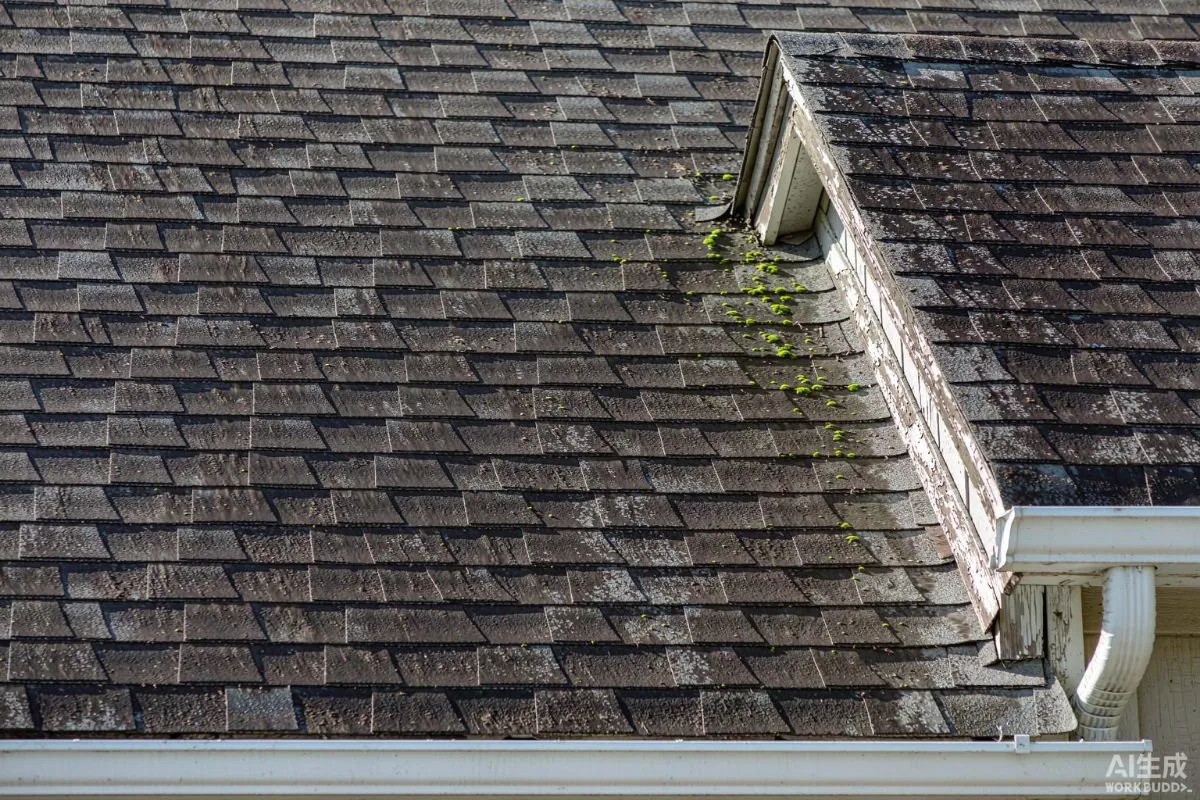
How to use the Overlay vs Tear-Off Calculator
Six fields and no calculate button. The comparison updates as you type.
Enter the area and the installed rate
The area is the sloped area being covered, and it is shared by both options. The installed rate is material and labour for the new covering, also shared — which is what isolates the cost of stripping as the only up-front difference.
If your contractor prices an overlay and a strip differently — and many do, because an overlay sometimes needs longer fasteners — run the comparison twice with each rate and treat the result as a range. The estimate roof replacement cost page builds the installed rate from material, labour and tear-off if you do not have one.
Enter the tear-off and the container
The tear-off rate covers stripping and disposal per square foot; the container is the fixed cost of the skip. Together they are the whole up-front penalty for choosing the strip. The roofing dumpster size calculator sizes the container if you are not sure what to allow.
Enter two service lives
These are the inputs that decide the result, and they are not the same number. A strip and re-cover gives the new covering a full life; an overlay does not, because the layer beneath it is already aged and any failure in it shows through.
Be conservative with the overlay figure. If a covering is rated 25 years, an overlay over a fifteen-year-old roof is not a 25-year proposition — something in the mid-teens is more honest, and the next section shows how sensitive the answer is to it.
Read the result
The large figure is the winner's cost per year. The sub-line names which option won, the annual gap, and how the up-front costs compare.
Four tiles follow: the two costs and the two annual figures. The pattern between them is the decision — if the cheaper option today is the dearer one per year, you are looking at a deferred cost rather than a saving.
Open Show calculation to see both workings side by side.
Saving and sharing the result
- Copy results copies both costs and both annual figures.
- Share opens the device's share sheet where one exists, and otherwise copies the link.
- Save image downloads a summary card as a PNG.
- Print / PDF opens the print dialog with a report laid out for paper.
- Cite and Embed open panels with a citation and an iframe snippet respectively.
- Reset returns every field to the default comparison.
If the calculator refuses a figure
An out-of-range entry hides the results and shows a "Check the input" message naming the field. The usual causes are an area of zero, an installed rate of zero, and a service life below one year.
Correct the field and the result returns immediately. While the input is invalid the action buttons refuse to act, so a bad figure cannot be copied or printed by mistake.
Formula and calculation logic
strip = area × (installed rate + tear-off rate) + container
per year = cost ÷ service life
difference up front = strip − overlay
Variables
- area
- Sloped roof area, in square feet. Shared by both options.
- installed rate
- Material and labour for the new covering, in dollars per square foot.
- tear-off rate
- Stripping and disposal, in dollars per square foot.
- container
- The skip, in dollars. A fixed cost that does not scale with area.
Unit explanation
The area multiplies two per-square-foot rates to give dollars, and the container is added as a lump sum. Dividing by a life in years gives dollars per year. Both options use the same area and the same installed rate, so those cancel out of the comparison entirely — what remains is the strip cost spread over the extra life it buys.
The container is the one figure that behaves differently from the rest: it does not scale with the roof, so on a small roof it is a larger share of the strip premium, and on a very large roof it nearly disappears.
How the winner is chosen
The lower cost per year wins. The up-front difference is reported but does not affect the verdict, so an overlay that saves thousands today will still be called the loser if it costs more per year. A tie goes to the overlay.
That is the right criterion for the question being asked — which is cheaper to own — but it is not the same question as which is affordable now, and the two can point in opposite directions.
What the comparison reduces to
Because the installed rate is shared, the overlay wins when the extra life bought by stripping is worth more than the strip costs. Written out, the strip wins when:
At the defaults, $7.63 over 25 years is $0.305 per sq ft per year against $5.63 over 15 at $0.375 — so the strip is cheaper per square foot per year despite costing more up front.
Numerical example
1,600 sq ft at $5.63 installed, $2.00 tear-off and a $500 container, with a 15-year overlay and a 25-year strip:
- overlay
- 1,600 × $5.63 = $9,008
- strip
- 1,600 × $7.63 + $500 = $12,708
- difference up front
- $12,708 − $9,008 = $3,700
- overlay per year
- $9,008 ÷ 15 = $600.53
- strip per year
- $12,708 ÷ 25 = $508.32
- difference per year
- $600.53 − $508.32 = $92.21
Nothing is rounded, and the display shows whole dollars for the costs and cents for the annual figures.
Result interpretation
The per-year figure is what each option costs you across the life it delivers. It is not a cash-flow forecast: the overlay genuinely leaves $3,700 in your account today, and no per-year figure changes that.
A deferred cost, not a saved one
The overlay avoids a strip now. It does not avoid one later — when the roof is next replaced, both layers come off, and that strip is more expensive than the one that was skipped.
On the default numbers the overlay saves $3,700 immediately but costs $92.21 a year more. The per-year figure already reflects the shorter life, which is why it is the only fair basis for comparing the two: any total over a fixed number of years depends on whose life you choose to measure over.
Over the overlay's own fifteen years the extra cost is about $1,380, which is less than the $3,700 saved — but at fifteen years the strip option still has ten years of life left, so that comparison flatters the overlay. Over the strip's twenty-five years the overlay would need replacing once, and the position reverses.
What the second strip will cost is a real number you could estimate, and the roof tear-off cost calculator prices a strip on its own. Adding it to the overlay side is the honest way to compare the two over a long horizon.
Is an overlay even allowed?
Before the arithmetic matters, the overlay has to be permitted and sensible. The guidance from the asphalt roofing industry body is worth working through, because several of its conditions would rule an overlay out regardless of cost.
The two-layer limit
Most building codes limit the number of coverings a roof may carry, and most do not allow more than two. So a roof that already has two layers is a strip by law in most jurisdictions, not a choice — and local codes may set a different limit, so the applicable code governs.
Conditions that require a strip
The same guidance lists conditions under which the existing shingles will likely need to be removed:
- The roof already has two layers of shingles.
- The structure shows signs of sagging across the ridge or truss lines — which warrants inspection by a licensed structural engineer.
- An inspection of the deck reveals rotted or warped wood, or gaps greater than a quarter inch between boards.
- The existing shingles are so uneven or distorted that the new covering could not lie flat.
Three of those four can only be established by looking, which means an overlay decision taken without opening anything up is a decision made on incomplete information. That is the strongest argument for stripping: it is the only option that lets you see the deck.
Weight and fastening
An extra layer adds load to the structure and changes how the new covering is fixed. Both need checking rather than assuming: the structure has to be able to carry another layer, and the deck has to be sound enough to hold the fasteners. The roofing delivery weight calculator covers the weight side.
What the manufacturer allows
Not every product can be overlaid. Most manufacturers do not recommend installing new shingles over existing laminated shingles, and impact resistance ratings may be affected when new shingles go over old ones. Check the specific product before treating an overlay as available.
Where the guidance says an overlay is reasonable — a single flat layer on a sound deck — it also notes the existing layer acts as a secondary backup and saves the cost and inconvenience of removal. That is the case the calculator is good at pricing. The others are not cost questions at all.
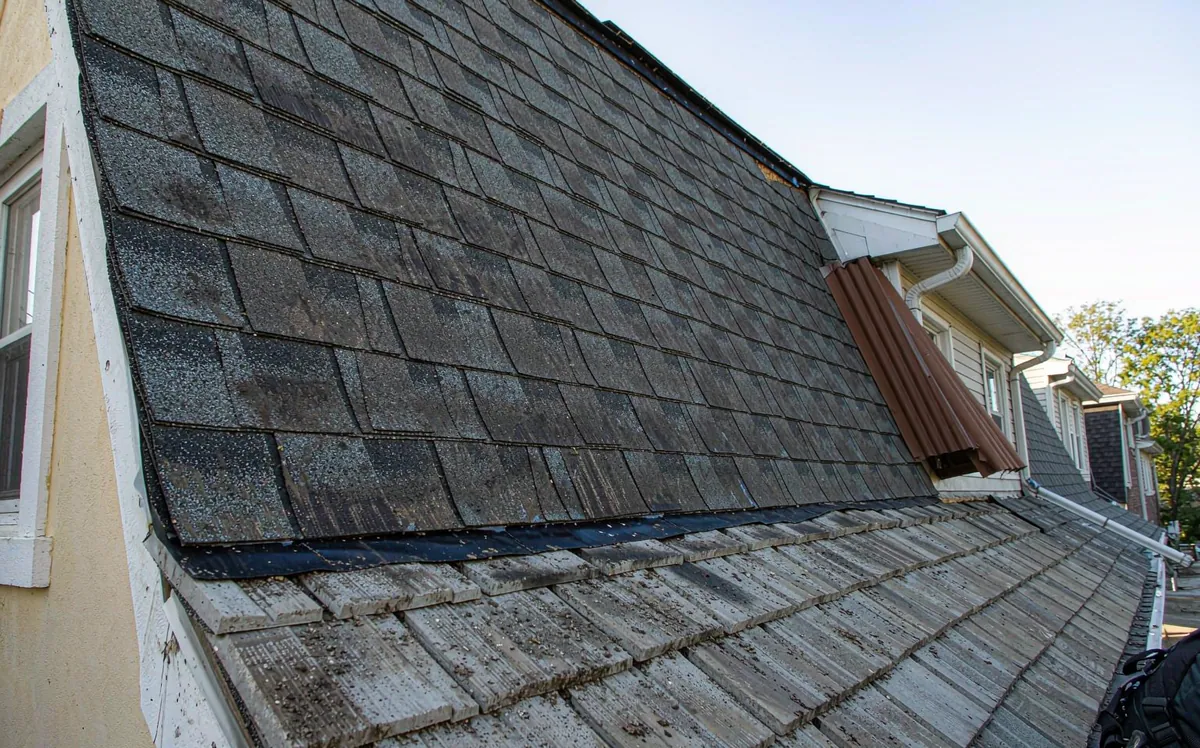
Worked examples
Example 1 — 1,600 sq ft, overlay against strip
- Inputs
- 1,600 sq ft at $5.63 installed, $2.00 tear-off, $500 container, 15-year overlay, 25-year strip
- Overlay
- 1,600 × $5.63 = $9,008
- Strip
- 1,600 × $7.63 + $500 = $12,708
- Difference up front
- $3,700 cheaper to overlay
- Overlay per year
- $9,008 ÷ 15 = $600.53
- Strip per year
- $12,708 ÷ 25 = $508.32
- Difference per year
- $92.21 cheaper to strip
The cheaper option today is the dearer one per year. That is the whole argument, and it is worth noting that the strip is cheaper per year despite costing $3,700 more.
Example 2 — an overlay with a shorter life
- Change
- overlay life 10 years, everything else as Example 1
- Overlay per year
- $9,008 ÷ 10 = $900.80
- Strip per year
- $508.32
- Difference
- $392.48 a year worse
- Over 10 years
- $3,925 — more than the $3,700 saved
At a ten-year life the overlay gives back everything it saved, and then some. A roof already near the end of its life is exactly where an overlay looks cheapest and performs worst.
Example 3 — how long the overlay would need to last
Example 1's costs, with the question reversed: what overlay life would make it cheaper per year than the strip?
- Target annual cost
- $508.32, to match the strip
- Required life
- $9,008 ÷ $508.32 = 17.7 years
- Assumed life
- 15 years, which is 2.7 short
That is the useful way to read a losing comparison. The overlay is not hopeless — it needs to last 17.7 years rather than 15, and on a roof with a sound single layer that is not an unreasonable expectation. The decision turns on a forecast, not on the price.
| Overlay life | Overlay per year | Against strip at $508.32 |
|---|---|---|
| 10 years | $900.80 | Strip wins by $392.48 |
| 15 years | $600.53 | Strip wins by $92.21 |
| 17 years | $529.88 | Strip wins by $21.56 |
| 18 years | $500.44 | Overlay wins by $7.88 |
| 20 years | $450.40 | Overlay wins by $57.92 |
| 25 years | $360.32 | Overlay wins by $148.00 |
A $9,008 overlay against a $12,708 strip throughout, changing only the overlay's service life. The verdict flips between 17 and 18 years, so the honest answer is that it depends on how long the overlay really lasts.
| Tear-off rate | Strip cost | Strip per year | Against overlay at $600.53 |
|---|---|---|---|
| $1.00 | $11,108 | $444.32 | Strip wins by $156.21 |
| $2.00 | $12,708 | $508.32 | Strip wins by $92.21 |
| $3.00 | $14,308 | $572.32 | Strip wins by $28.21 |
| $3.45 | $15,028 | $601.12 | Overlay wins by $0.59 |
| $4.00 | $15,908 | $636.32 | Overlay wins by $35.79 |
The overlay at 15 years throughout, changing only the tear-off rate. The overlay starts to win once stripping costs about $3.44 per square foot, which is well above the $2.00 default.
Limitations and assumptions
- Same installed rate both ways. Real quotes differ, often because an overlay needs different fasteners.
- No warranty difference. Overlays often reduce or void cover, and that is not priced.
- No code check. Whether an overlay is permitted is a local question, and most codes cap the layers at two.
- No deck repairs. A strip exposes the deck, and any rot or failed sheathing is extra. The calculator assumes none.
- No second cycle. The cost of stripping two layers later is not modelled.
- No structural check. The extra weight and the fastener capacity are not assessed.
- No discounting. Future money is treated as equal to present money, which favours the overlay.
- Figures are yours. The defaults are illustrative.
The deck repair exclusion is the one most likely to change a real decision. A strip that finds rotten sheathing adds cost the overlay would never have discovered, but the overlay would have covered it up — so the comparison is not simply missing a number, it is missing the reason the strip exists.
Where the job is being priced for a bid rather than a budget, the roofing bid calculator adds overhead and margin to whichever option you choose. Where access is difficult or the roof is unusually steep, the roof cost factor and accessibility calculator adjusts the rates before they come here.
Frequently asked questions
A new covering installed over an existing one rather than in place of it. The industry term is a roof recover. It avoids stripping, disposal and the container, which is the whole of the saving — the covering itself costs the same to buy and fit.
Because the two options do not last the same length of time, so their up-front costs are not comparable figures. An overlay that saves $3,700 today but delivers ten fewer years is not cheaper — it is cheaper now. Dividing by life puts both on the same scale.
Not always. Most building codes limit a roof to two coverings, so a roof that already has two layers is a strip by law in most places. Beyond the code, a strip is also required where the structure is sagging, where the deck has rot or gaps over a quarter inch, or where the old shingles are too uneven to lay a new covering flat.
Both layers come off, and stripping two costs more than stripping one. The calculator does not model that second strip, which is one reason an overlay can look better here than it does over a full replacement cycle. Adding the second strip to the overlay side is the honest correction.
Often yes, because an overlay may need longer fasteners to reach through both layers, and the covering sometimes has to be a different product. The calculator uses one rate for both, which isolates the strip cost cleanly but makes the comparison approximate. If your quotes differ, run it twice and treat the answer as a range.
They convert each up-front cost into an annual one, which is the only way to compare options with different lifetimes. They are also the inputs that decide the result: on the default comparison the verdict flips between a 17 and an 18 year overlay life, so the honest answer depends on how long the overlay really lasts.
Usually, and not in your favour. Many manufacturers will not warrant a covering installed over an existing one, and the product's impact rating may not carry over. That is a real cost that the arithmetic does not carry, and it is worth establishing before the overlay is chosen rather than after.
They are illustrative. The $5.63 installed rate, $2.00 tear-off, $500 container and the 15 and 25 year lives are round figures chosen so the arithmetic is easy to follow. Replace all six with figures from quotes for your roof.
Because the assembly is only as good as the layer underneath it. The new shingles are new, but the old covering is already part way through its life, any failure in it shows through, and the deck beneath it remains uninspected. The covering's own rating assumes a new roof, not a second-hand one.
On cost per year alone. The up-front difference is shown but does not influence the verdict, and an exact tie is resolved in the overlay's favour. So an overlay that saves thousands today will still be called the loser if it costs more per year — which is the right answer to "which is cheaper to own" but not to "which can I afford now".
It could, in either direction. A strip exposes the deck, and any rot found is extra cost the calculator does not include — so it can make the strip dearer. But an overlay covers that deck without anyone seeing it, so the comparison is not merely missing a number; it is missing the reason the strip exists.
Not directly — the calculator takes one tear-off rate and applies it to the strip option only. You can approximate it by raising the overlay's installed rate to cover a future strip spread across its life, or by comparing over two cycles on paper. Either way, the second strip is the overlay's real weakness and it belongs in any long-horizon comparison.
Where these numbers come from
Every figure is yours. The page prices both options on the same area and rate, then divides by service life; it estimates nothing and embeds no price list.
The defaults are illustrative. Service life is the input that decides the comparison, and it is a range rather than a fact — particularly for the overlay, where it depends on the age of what lies underneath.
One external source supports the statements about what an overlay requires:
- Asphalt Roofing Manufacturers Association — Re-Roofing: Replacement vs Recover — the source for the code and condition checks described on this page. It defines a recover as installing an additional covering over an existing one, and records that most building codes do not allow more than two coverings on a building. It lists the conditions under which existing shingles will likely need to be removed: two layers already present, sagging across the ridge or truss lines, rotted or warped deck boards or gaps over a quarter inch, and shingles too uneven to lay a new covering flat. It notes that replacement allows the deck to be inspected and repaired, that the structure must be able to carry another layer, that most manufacturers do not recommend overlaying existing laminated shingles, and that impact resistance ratings may be affected.
That is industry guidance rather than a code. The applicable building code and the product manufacturer's instructions govern, and they differ by jurisdiction — the two-layer limit in particular is stated as a common rule rather than a universal one.
What the page cannot tell you is whether an overlay is available on your roof. Three of the four conditions that force a strip can only be established by looking, which is why the decision usually needs someone on the roof before the arithmetic is worth doing.
What does the strip cost on its own?
The tear-off calculator prices removal, disposal and container separately.