
Roof Snow Removal Cost Calculator
Work out what it costs to clear a roof: the area, the rate per visit, how often it snows, and the minimum charge that can override the rate on a small roof.
Quick answer: a 1,500 sq ft roof at $0.35 per square foot, cleared three times a season with a $250 minimum, costs $525 a visit — $1,575 for the season. The minimum does not bite here; on a roof under about 714 sq ft it would.
- Per-visit minimum applied
- Season total shown
- Effective rate exposed
Inputs and results
The minimum applies per visit, so a season of short visits can be dominated by it.
- Roof area (sq ft)
- Rate ($ per sq ft)
- Visits per season
- Minimum charge per visit ($)
The effective rate shows what you actually paid per square foot after the minimum was applied.
Show calculation
Snow removal inputs and results explained
Four inputs and three outputs. Two describe the roof and the rate, one is how often the work happens, and one is a floor that can quietly override the rate on a small roof.
| Input | What to enter, and where it comes from | Unit | Limits in the calculator |
|---|---|---|---|
| Roof area | The area actually cleared, not the whole footprint if only part is reachable | sq ft | 1 or more |
| Rate | The contractor's price per square foot, per visit | $ per sq ft | 0 or more |
| Visits per season | How many call-outs you expect, based on the site and the weather | visits | 1 or more |
| Minimum charge per visit | The floor in the contractor's terms, or zero if there is none | $ | 0 or more |
| Result | What it means | Unit |
|---|---|---|
| Cost per visit | The greater of area multiplied by rate, and the minimum charge | $ |
| Season total | Cost per visit multiplied by the number of visits | $ |
| Effective rate | Cost per visit divided by the area — what you actually paid per square foot | $ per sq ft |
The minimum is charged per visit, not per season. A winter of six light falls is billed as six minimums, which can exceed a single heavy clearance on the same roof.
The calculator refuses an area below 1 sq ft, a negative rate or minimum, and fewer than one visit. It accepts a fractional rate, so a quote in cents per square foot can be entered directly.
What this calculator works out
Snow removal is priced per visit rather than per season, because the work is a call-out each time it snows. A minimum charge per visit is normal, and on light falls it is the minimum rather than the area that sets the price.
This calculator applies your rate to the area, compares it with the minimum, and multiplies by the number of visits you expect.
Before the arithmetic, though, there is a cheaper answer that the industry's own safety guidance points at. Employers are advised to consider options that avoid working on roofs and elevated surfaces altogether — because the removal itself is the hazard. A snow rake operated from the ground, a roof designed to shed its load, or simply leaving a sound roof alone are all cheaper than a fall.
What this page prices is the third-best option: paying someone to go up there. Whether that is necessary is a load question rather than a cost one, and the snow load calculator answers it. Where the concern is ice rather than depth, the ice dam risk calculator covers the conditions that produce it.
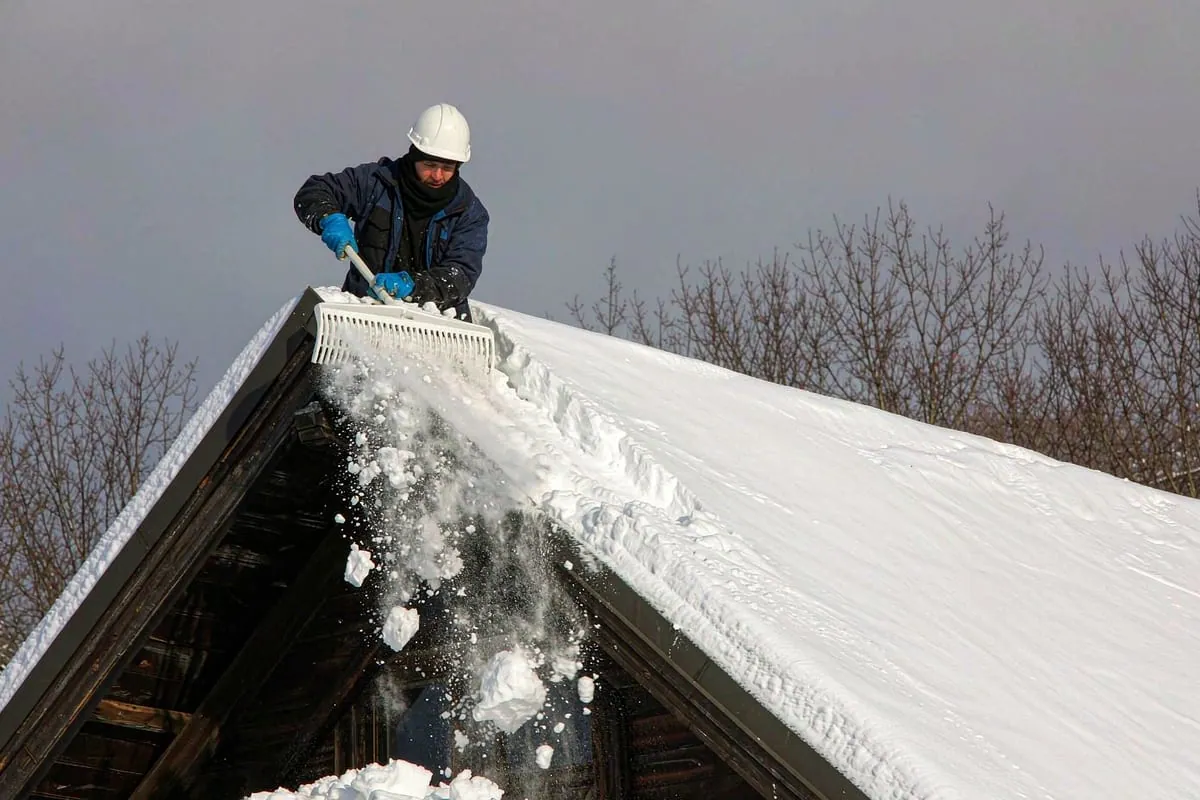
How to use the Roof Snow Removal Cost Calculator
Four fields and no calculate button. The results update as you type.
Enter the roof area
The area actually cleared, which is often less than the roof. A contractor working from ladders or from the ground with a rake reaches the lower slopes and the eaves, not the whole plane. If only part of the roof is accessible, price only that part — entering the full area overstates a job that will not happen.
Enter the rate
The contractor's price per square foot, per visit. Ask whether it is quoted on the cleared area or on the whole roof, because the two produce very different totals on a roof that is only partly reachable.
Enter the visits per season
This is the least predictable input on the page and the one that moves the total most. It is a guess about the weather, and the only honest way to make it is from the site's history: how many times last winter did the roof need clearing, and how many times was it done as a precaution rather than a necessity.
Agreeing a visit count in advance, or a seasonal arrangement with a cap, converts an open-ended weather risk into a known cost.
Enter the minimum charge
The floor in the contractor's terms, per visit, or zero if there is none. On a small roof this is what you actually pay, and the effective rate will show it.
Read the result
The large figure is the cost per visit. Two tiles follow: the season total and the effective rate.
The effective rate is the diagnostic. When it equals the rate you entered, the area is setting the price. When it is higher, the minimum is doing the work — and on a small roof it can be several times the quoted rate.
Open Show calculation to see each line with your figures in it.
Saving and sharing the result
- Copy results copies the per-visit cost, the season total and the effective rate.
- Share opens the device's share sheet where one exists, and otherwise copies the link.
- Save image downloads a summary card as a PNG.
- Print / PDF opens the print dialog with a report laid out for paper.
- Cite and Embed open panels with a citation and an iframe snippet respectively.
- Reset returns every field to the 1,500 sq ft example.
If the calculator refuses a figure
An out-of-range entry hides the results and shows a "Check the input" message naming the field. In practice that means an area below 1 sq ft, a negative rate, or fewer than one visit.
Correct the field and the result returns immediately. While the input is invalid the action buttons refuse to act, so a bad figure cannot be copied or printed by mistake.
Formula and calculation logic
cost per visit = max(area charge, M)
season total = cost per visit × V
effective rate = cost per visit ÷ A
Variables
- A
- Roof area cleared, in square feet.
- R
- Rate, in dollars per square foot per visit.
- M
- Minimum charge per visit, in dollars.
- V
- Visits per season.
Unit explanation
Square feet multiplied by dollars per square foot gives dollars for one visit; multiplying by the visit count gives dollars for the season. The effective rate divides dollars back by square feet, so it is in the same unit as the rate you entered — which is what makes the comparison between them meaningful.
That is the whole purpose of the effective rate: it puts the charged price back onto the same scale as the quoted one, so you can see at a glance whether you are paying the rate or the floor.
Why the minimum is a maximum, not an addition
The floor is a minimum charge, so the calculator takes the greater of the area charge and the minimum rather than adding them. A contractor quoting "35 cents a square foot, minimum $250" means one or the other, not both.
It is charged per visit, which is the part people miss. Three visits at the floor is three minimums, not one season-long minimum.
Numerical example
1,500 sq ft at $0.35 per square foot, three visits, with a $250 minimum:
- area charge
- 1,500 × $0.35 = $525
- cost per visit
- max($525, $250) = $525
- season total
- $525 × 3 = $1,575
- effective rate
- $525 ÷ 1,500 = $0.35
The minimum does not bind here, which is why the effective rate equals the rate entered. On a small roof the two diverge.
Result interpretation
The season total is a budget figure built on an assumption about how often it snows. Treat it as a planning number rather than a commitment: the per-visit cost is contractual, the visit count is not.
The minimum charge, and the visits multiplier
The floor binds on small roofs, and where it binds it raises the effective rate above the quoted one. The threshold is the minimum divided by the rate: at $0.35 with a $250 floor that is about 714 sq ft, and anything below it is billed at the minimum.
| Roof area | Area charge at $0.35 | Charged per visit | Effective rate |
|---|---|---|---|
| 400 sq ft | $140 | $250 | $0.63 |
| 600 sq ft | $210 | $250 | $0.42 |
| 714 sq ft | $250 | $250 | $0.35 |
| 1,000 sq ft | $350 | $350 | $0.35 |
| 1,500 sq ft | $525 | $525 | $0.35 |
| 3,000 sq ft | $1,050 | $1,050 | $0.35 |
A $0.35 rate with a $250 minimum throughout. Below 714 sq ft the floor sets the price and the effective rate climbs; at and above it the rate applies exactly as quoted.
A 400 sq ft roof is charged at an effective $0.63 a square foot, nearly twice the quoted rate. Nobody at the contractor's office will explain that, because the schedule is behaving exactly as written — but it is the reason a small roof feels expensive to clear.
Visits multiply everything, including the floor
There is no seasonal discount in the arithmetic. Each visit is priced independently, so the season total is a straight multiple of the per-visit cost — and if the floor is binding, it is a straight multiple of the floor.
| Visits | Season total at $525 per visit | Season total at the $250 floor |
|---|---|---|
| 1 | $525 | $250 |
| 2 | $1,050 | $500 |
| 3 | $1,575 | $750 |
| 4 | $2,100 | $1,000 |
| 6 | $3,150 | $1,500 |
| 8 | $4,200 | $2,000 |
The same roof, priced at the rate and at the floor. Which column you are in depends entirely on the area — and the visit count scales either one without changing the relationship.
Two ways to change the shape of the bill follow from that. Prevention — a roof that sheds its load, or a guard that keeps it from sliding onto a doorway — reduces the visits rather than the rate, which is where the money is. The roof snow guard calculator covers the hardware, and the calculate roof material comparison compares coverings on how they perform over their life rather than on what they cost to clear.

Worked examples
Example 1 — the default inputs
- Inputs
- 1,500 sq ft, $0.35 per sq ft, 3 visits, $250 minimum
- Area charge
- 1,500 × $0.35 = $525
- Cost per visit
- max($525, $250) = $525
- Season total
- $525 × 3 = $1,575
- Effective rate
- $0.35
The minimum does not bind on this roof — the area charge is more than twice the floor. The effective rate matching the quoted rate is the sign of that.
Example 2 — a larger roof and a longer season
- Inputs
- 3,000 sq ft, $0.40 per sq ft, 4 visits, $250 minimum
- Area charge
- 3,000 × $0.40 = $1,200
- Cost per visit
- max($1,200, $250) = $1,200
- Season total
- $1,200 × 4 = $4,800
- Effective rate
- $0.40
Doubling the area and raising the rate lifts the per-visit cost by 2.3 times; the extra visit takes the season total to 3.0 times Example 1's. Neither figure is at the floor.
Example 3 — a small roof where the floor takes over
- Inputs
- 400 sq ft, $0.35 per sq ft, 3 visits, $250 minimum
- Area charge
- 400 × $0.35 = $140
- Cost per visit
- max($140, $250) = $250 — the floor applies
- Season total
- $250 × 3 = $750
- Effective rate
- $250 ÷ 400 = $0.63
The quoted rate was $0.35 and the effective rate is $0.63 — nearly double. On a roof this size the floor, not the rate, is the price.
Limitations and assumptions
- The visit count is a guess. It is the least predictable input and the one that moves the total most.
- Same area every visit. In practice a light fall may only need the valleys and a heavy one the whole roof.
- No ice treatment. De-icing, salt and ice melt are usually separate line items.
- No disposal. Where snow has to be hauled rather than pushed off, that is an extra.
- No access surcharge. Steep, tall or obstructed roofs are often priced higher than the schedule rate.
- No damage liability. A rake taken to a brittle covering, or a buried skylight, is a separate problem.
- No seasonal contract pricing. Many contractors price a season differently from a series of call-outs, and the calculator only models the second.
- Figures are yours. The defaults are illustrative.
The visit-count problem is the one worth solving before the arithmetic. A contractor who will agree a capped seasonal price turns an unpredictable bill into a fixed one, and that is worth paying a premium for — the calculator cannot show it, because it prices visits rather than seasons.
Two related costs sit outside this page. If the snow has already done damage, the new roof cost estimator prices the consequence. Where the problem is ice rather than depth, the ice melt cable calculator and the roof ice barrier width calculator cover the two common defences.
Frequently asked questions
Because the work is a call-out each time it snows, and the contractor carries the mobilisation cost every time. There is no economy of scale in the arithmetic: the second visit costs the same as the first, which is why a winter of light falls is expensive relative to the snow that fell.
Whether you are paying the rate or the floor. When the effective rate equals the rate you entered, the area is setting the price. When it is higher, the minimum is doing the work — and on a small roof it can be nearly double the quoted rate, which is why a modest roof feels expensive to clear.
Because each visit is a separate job with its own mobilisation. Three visits at the floor is three minimums, not one season-long minimum. That is the part people miss when they budget a season: six light falls billed at the floor can exceed one heavy clearance on the same roof.
From the site's history rather than the forecast. Ask how many times last winter the roof was cleared, and how many of those were precautionary rather than necessary. That second number is the one to cut, because a precautionary visit is a full charge for snow that may not have needed moving.
Usually, and it avoids the fall hazard entirely. A long-handled rake reaches the lower slope and the eaves, which is where ice dams form and where the load is most visible. What it cannot do is clear the upper roof, so on a deep fall it is a partial answer rather than a replacement.
No. Salt, ice melt and de-icing are usually separate line items, and on some roofs they are best avoided altogether because of what they do to the covering and to the plants below. Ask what is included before comparing two quotes on the rate alone.
Often yes, and it is worth asking. A capped seasonal contract converts an open-ended weather risk into a known cost, which is usually worth a premium over the per-visit rate. This calculator prices visits rather than seasons, so it cannot show you that trade — it will only tell you what the call-out model costs.
It depends on the depth, the density of the snow and the load the roof was designed for — wet snow is several times heavier than dry powder for the same depth. There is no single depth that is safe everywhere, which is why the load rather than the depth is the thing to check. That is a structural question, not a costing one.
It carries real risk. Snow hides skylights, vents and the roof edge, the surface is slippery, and ladders are difficult to set safely in winter conditions. Safety guidance for the trades recommends considering ways to avoid working on roofs at all — and the same logic applies to a homeowner. If someone has to go up, that is a job for someone trained and equipped for it.
Yes. A metal blade dragged across an asphalt or tile covering can lift, crack or scuff it, and the damage often shows up as a leak months later. That is a reason to ask what tool a contractor uses, and a reason to prefer a plastic rake from the ground over a blade on the roof.
They are the main hidden hazard once snow is deep. A skylight covered by snow looks exactly like roof, and standing on one is a fall through it. Marking their positions before winter, or having the contractor confirm them on arrival, costs nothing and is the single most useful precaution on a roof with either.
They are illustrative. The 1,500 sq ft area, $0.35 rate, three visits and $250 minimum are round figures chosen so the arithmetic is easy to follow. Rates and minimums vary widely by region and by contractor, so replace all four with figures from a local quote.
Where these numbers come from
Every figure on this page comes from you. The page applies the greater of an area charge and a minimum, multiplies by the visit count, and divides back to an effective rate. It embeds no rate and no assumption about how often it snows.
The defaults are illustrative. Rates and minimums vary widely by region and by contractor, and the visit count is a guess about the weather rather than a quotation.
One external source supports the safety statements on this page:
- Occupational Safety and Health Administration — Winter Weather — federal guidance on winter hazards, including a section headed “Preventing Falls When Removing Snow from Rooftops and Other Elevated Surfaces”. It advises that employers should consider options to avoid working on roofs or elevated heights, and where work on a roof is unavoidable requires fall protection and training, safe ladder use including clearing snow and ice from surfaces, extreme caution near power lines, and protection from cold exposure and physical exertion. That is the basis for this page's position that the cheapest removal is the one that does not need doing, and that ground-level raking is preferable to sending anyone onto the roof.
That guidance is written for employers rather than householders, and the duties it sets out apply to work, not to a homeowner clearing their own roof. The hazard is the same either way, which is why the advice transfers even though the legal duty does not.
No source is cited for the rates or the visit counts, because the page asserts none. Both come from a local contractor and from the site's own history.
Checking the load instead?
The snow load calculator converts ground snow to roof load.