
Roof Repair Cost Calculator
Price a roof repair from the number of repairs, the cost of each, any special materials and an access surcharge — and see what one repair really costs once the extras are spread across the job.
Quick answer: three repairs at $450 each, $250 of materials and a 10% access surcharge comes to $1,760 — $586.67 per repair.
- Priced per repair, not per square
- Access surcharge separated
- Cost per repair for comparison
Repair cost inputs and results
Repair prices vary more than almost any other roofing figure, so the default is a shape rather than a rate.
- Number of repairs
- Cost per repair ($)
- Special materials ($)
- Access surcharge (%)
An estimate from your figures; anything found once the repair is opened is outside it.
Show calculation
What a roof repair usually costs
Published US cost data puts a single roof repair somewhere between $150 and $1,500 for common damage, with a typical job landing around $800 to $1,150. A vent boot or a handful of lifted shingles sits at the bottom of that range. A repair that opens the deck, involves several trades or needs access equipment sits at the top.
That range is context, not a quote. It tells you whether a number you have been given is ordinary or unusual. This calculator does a different job: it takes the figures you supply and turns them into a total and a cost per repair.
| Scope | Typical range | What usually puts a job here |
|---|---|---|
| Minor or patch | $150 – $1,000 | One area, no decking opened, single visit, standard access |
| Moderate | $1,000 – $3,000 | Several areas, a component replaced, or one elevation of flashing |
| Major | $2,000 – $6,000+ | Decking or framing, multiple trades, scaffold or lift access |
Market ranges from published third-party cost data (see Sources). They are not output from this calculator and they are not local to your area.
What this calculator works out
The calculator adds up the cost of several repairs at the same time, adds any materials that are specific to the job, and applies an access surcharge on top. It returns a total and an average cost per repair.
It is a build-your-own estimate, not a price list. It does not know what a shingle repair costs in your area, what your contractor charges an hour, or how bad the damage is. You supply the cost per repair; the calculator does the arithmetic, the aggregation and the per-repair average.
That distinction matters. A tool that guesses a price from a dropdown will be wrong for most houses. A tool that totals the numbers you already have stays correct as long as your inputs are right — and it shows you exactly where the total came from, line by line.
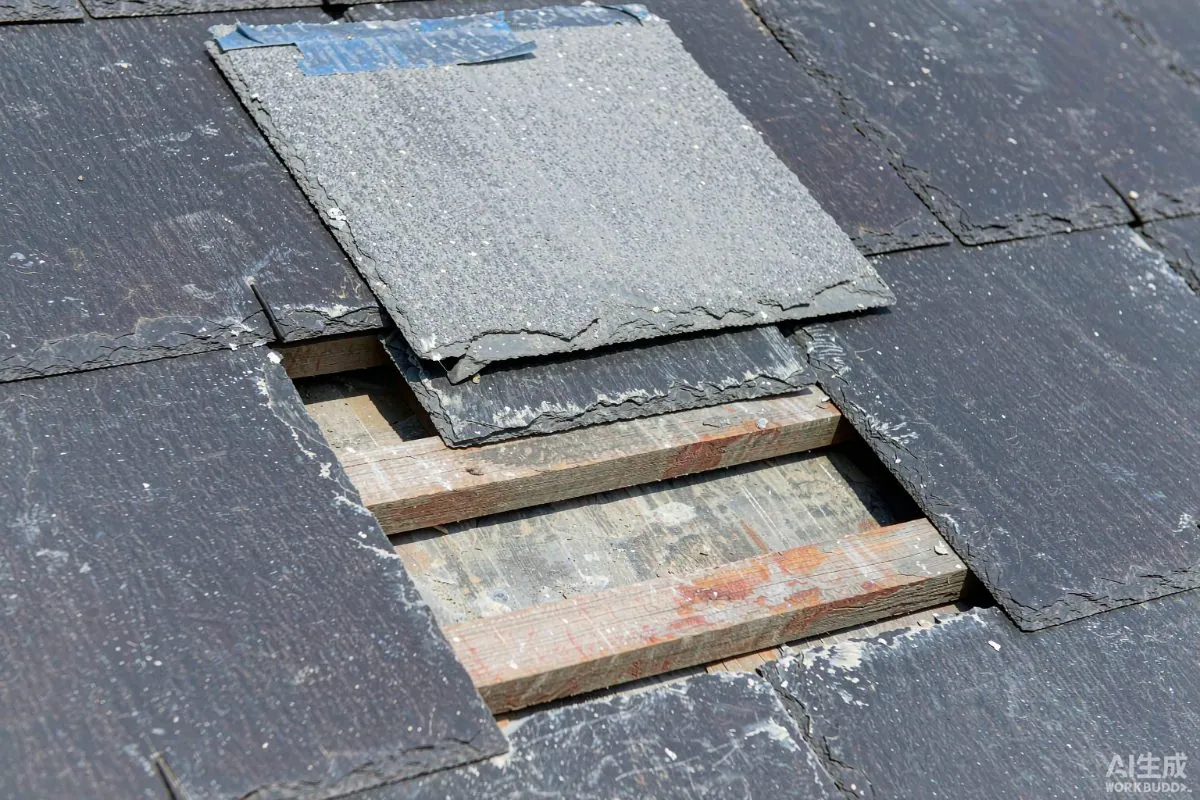
Inputs and results explained
Four inputs, five outputs. Each input has a limit built into the calculator, and going outside it returns a message rather than a wrong answer.
| Input | What to enter | Limits |
|---|---|---|
| Number of repairs | How many separate jobs are priced. Two patches billed separately are two repairs | Whole number, 1 to 200 |
| Cost per repair ($) | The price of one typical repair, from a quote or a published benchmark | 0 to $100,000 |
| Special materials ($) | Anything specific a standard price would not cover: matching tile, a vent, flashing | 0 or more |
| Access surcharge (%) | What the contractor adds for scaffold, height or pitch. Set 0 if access is already included | 0 to 100 |
| Output | What it means | Unit |
|---|---|---|
| Repairs line | Number of repairs multiplied by the cost per repair | $ |
| Special materials | The materials figure you entered, shown as its own line | $ |
| Access surcharge | The percentage applied to repairs plus materials | $ |
| Estimated total | Repairs plus materials plus the access surcharge | $ |
| Cost per repair | Total divided by the number of repairs, to two decimals | $ |
The cost-per-repair output is the number most people miss. On a multi-repair job it is what tells you whether the second and third repairs are good value or whether you are being charged a full visit each time.
How to use the Roof Repair Cost Calculator
- Count the repairs. List each job separately: the vent boot, the three lifted shingles, the flashing at the chimney. If a contractor would bill them as one visit with one price, enter 1 and use the visit price.
- Enter the cost per repair. This is the figure that decides everything. Use a real quote or a published benchmark for the same damage type, not an average across all roofing work.
- Add special materials. Only materials that are specific to this job. Do not add labour here — it is already inside the per-repair price.
- Set the access surcharge. Zero if access is ordinary and already included. If your contractor prices scaffold or a lift separately, use the percentage that reflects it.
- Read the total, then read the per-repair figure. If the per-repair number is far above the benchmark for that damage type, the job is being priced as something bigger than it looks.
The calculator updates as you type, so it is worth moving the access percentage up and down to see how much of the total is driven by access rather than by the repair itself.
Where your cost-per-repair figure comes from
Labour is what sets the floor on any repair price. The US median wage for roofers was $26.65 an hour in May 2025, before employer costs, insurance and overhead — which is why even a twenty-minute repair carries a meaningful minimum charge.
The calculator cannot price a repair for you, so the quality of the result depends entirely on the per-repair figure you type in. The tables below are published market ranges by damage type and by covering material. Use them to check a quote, or to pick a defensible number when you have no quote yet.
| Damage | Typical range | Why it lands there |
|---|---|---|
| Vent or pipe boot | $75 – $250 | Small area, one component, no decking work |
| Missing or damaged shingles | $150 – $700 | Depends on how many courses are disturbed and whether matching shingles exist |
| Flashing repair | $200 – $600 | Chimney, valley or wall flashing; sealing only versus rebuilding the detail |
| Roof leak (unlocated) | $350 – $1,500 | Includes finding it; water often enters well above where it shows |
| Skylight leak | $300 – $800 | Curb and flashing work, or unit replacement |
| Hole in the roof | $150 – $1,200 | Decking almost always involved; the range is set by how much |
| Wind damage | $250 – $6,500 | Runs from a few shingles to several squares and edge metal |
Published market ranges, not this calculator's output. Local labour rates move these figures substantially.
| Covering | Typical range | What drives the difference |
|---|---|---|
| Asphalt shingle | $150 – $1,500 | Cheapest material, but colour matching on older roofs can force a larger area |
| Flat roof | $300 – $1,100 | Membrane patches and seam work; ponding often means more than one visit |
| Wood shake | $350 – $1,500 | Individual shakes can be swapped, but the surrounding course usually suffers |
| Metal | $500 – $2,000 | Fastener and seam repairs are quick; panel replacement is not |
| Clay or concrete tile | $500 – $2,500 | Breakage during access is the main risk, and matching tiles may not exist |
| Slate | $700 – $3,000 | Specialist labour and salvaged or matched slate |
Two things move a repair out of these bands. The first is decking. Once the covering is open and the sheathing underneath is soft, the job becomes a structural repair rather than a surface one — that is priced separately, and the roof sheathing calculator covers the board itself while the plywood replacement cost calculator prices a partial re-deck.
The second is the size of the patch relative to the covering. Replacing six shingles on a 15-year-old roof often means replacing a whole slope to get a colour match — at which point the shingle replacement calculator is the more honest tool, because the job has stopped being a repair.
Emergency work is a third case: same repair, different price. Out-of-hours call-out and uplifted labour typically add $100 to $300, which is what the emergency roof repair calculator models.
Setting the access surcharge
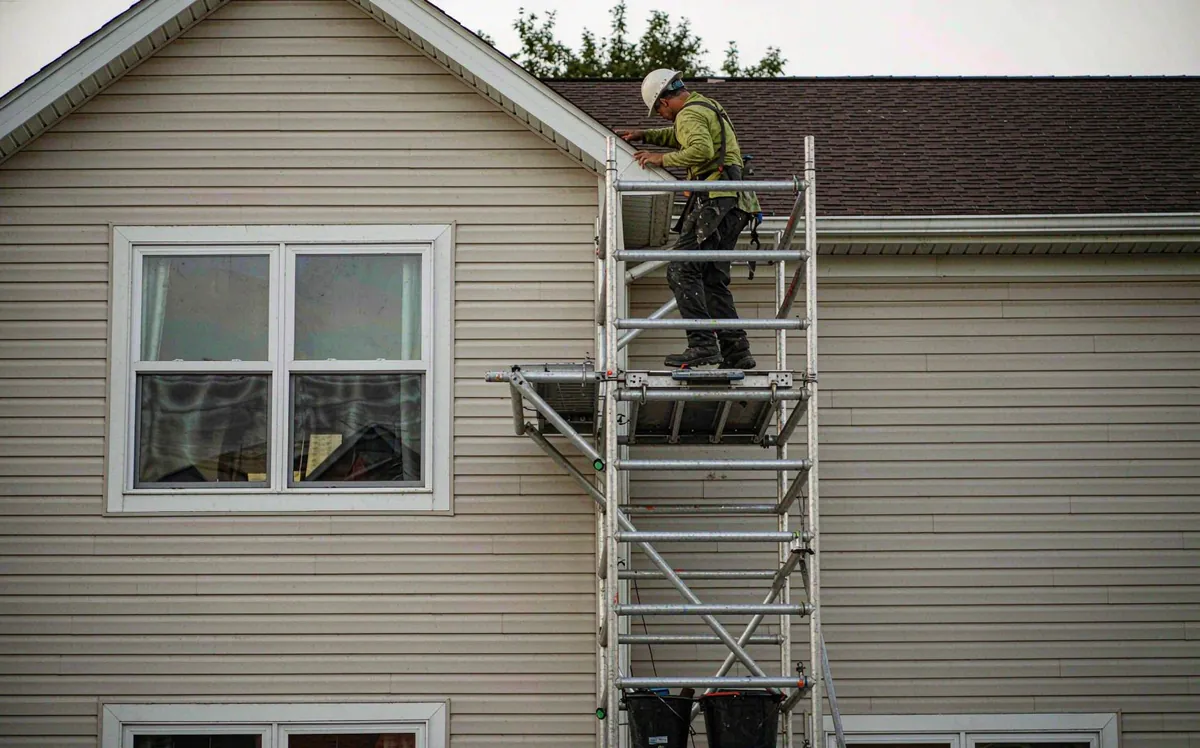
Access is the part of a repair quote that surprises people. The repair itself might be twenty minutes of work at the top of a ladder, but getting to it safely is what the contractor is really pricing: scaffold, a tower, a lift, roof anchors, or simply two people instead of one.
It is also a legal cost, not a convenience. In the US, OSHA requires fall protection once a worker is 6 feet (1.8 m) above a lower level, and steep roofs need guardrails with toeboards, safety nets or personal fall arrest systems. That equipment has to be bought, hired and installed before the repair starts, which is why the surcharge exists at all.
The calculator applies the surcharge to repairs plus materials, not to the repair line alone. That is deliberate — if the access is difficult, the materials have to be carried up the same way.
| Situation | Surcharge | Why |
|---|---|---|
| Single storey, ladder access, walkable pitch | 0% | Access is already inside the per-repair price |
| Two storey, or a pitch above 30° | 10 – 15% | Roof anchors, harness work, slower movement |
| Scaffold required | 15 – 25% | Erect, hire and dismantle, usually a separate invoice |
| Lift, or a roof with no safe edge access | 25%+ | Plant hire and a second operative |
Indicative working figures, not a published standard. Contractors price access differently by region and by job.
Formula and calculation logic
Four lines of arithmetic, in this order. No compounding, no rounding until the end.
| Step | Formula | What it produces |
|---|---|---|
| 1 | repairs = count × cost per repair | The cost of the repair work itself |
| 2 | subtotal = repairs + special materials | Everything before access |
| 3 | access = subtotal × (access % ÷ 100) | The access surcharge in dollars |
| 4 | total = subtotal + access | The estimate |
| 5 | per repair = total ÷ count | The average cost of one repair |
Variables. count is a whole number of repairs. cost per repair is in dollars. special materials is in dollars. access is a percentage and is divided by 100 before use — entering 10 means 10%, not 10 dollars.
Unit explanation. The only conversion in the calculation is the percentage to a decimal. It is also the step that goes wrong most often: applying 10 directly instead of 0.10 multiplies the surcharge by a hundred.
Why the surcharge is applied to the subtotal. Access is a cost of getting labour and materials to the roof, so it scales with both. Applying it to the repair line alone would understate jobs where the materials are heavy — tiles, slate, decking sheets.
Rounding. The calculator keeps full precision through the steps and rounds only for display: whole dollars where the value is within half a cent of a whole number, otherwise two decimals. The per-repair figure is always shown to two decimals, because dividing a total by a small repair count almost never gives a round number.
Worked examples
Three jobs with different shapes: a single visit, a multi-repair job, and a job where access dominates the price.
One repair, ordinary access
A leaking vent boot on a single-storey house. One repair at $1,200 including the boot and labour, no special materials, ordinary ladder access.
- repairs = 1 × $1,200 = $1,200
- subtotal = $1,200 + $0 = $1,200
- access = $1,200 × 0% = $0
- total = $1,200
- per repair = $1,200.00
The per-repair figure equals the total, which is the signature of a single-visit job. If a contractor quotes $1,200 for this and then adds a separate access charge, the access was not in the original price.
Three repairs, materials, standard access
Three separate repairs at $450 each, $250 of matching materials, and a 10% access surcharge for a two-storey house. This is the calculator's default example.
- repairs = 3 × $450 = $1,350
- subtotal = $1,350 + $250 = $1,600
- access = $1,600 × 10% = $160
- total = $1,600 + $160 = $1,760
- per repair = $1,760 ÷ 3 = $586.67
The per-repair figure of $586.67 is higher than the $450 repair price because each repair carries a share of the materials and the access. That gap is the real cost of bundling three jobs into one visit.
Six small repairs, scaffold access
Six small repairs at $180 each on a steep roof that needs scaffold, with $420 of materials and a 25% access surcharge.
- repairs = 6 × $180 = $1,080
- subtotal = $1,080 + $420 = $1,500
- access = $1,500 × 25% = $375
- total = $1,500 + $375 = $1,875
- per repair = $1,875 ÷ 6 = $312.50
Here the six repairs cost $1,080 but the job totals $1,875 — 42% of the price is materials and access. That is the pattern to look for when a quote for "a few small repairs" comes in well above the sum of the individual repair prices.
Repair or replace: the maths
The usual rule of thumb is that a repair is worth doing when it costs less than about half the price of a replacement and the roof has more than about five years of service left. That rule is crude, but it is a reasonable starting point because it prices the repair against the remaining life you would be buying with a new roof.
Run the comparison with real numbers. If the repair total from this calculator is $1,875 and a replacement on the same roof is quoted at $14,000, the repair is 13% of replacement — clearly worth doing. If the repair comes to $7,000 against the same $14,000, you are paying half the price of a new roof for a fraction of the life.
Two things break the rule. A repair that addresses a leak into the structure can be worth doing even at a high percentage, because water damage compounds. And a repair on a roof that is already at the end of its life is money spent on a surface that will be removed anyway.
The repair vs replace calculator runs that comparison directly, and the roof replacement cost calculator gives you the number to compare against.
Limitations and assumptions
The estimate is only as good as the cost per repair you enter. Everything else is arithmetic.
What it assumes.
- Every repair costs the same. If one repair is a vent boot and another is a valley rebuild, either price them separately or use an average and accept the loss of detail.
- Special materials are additional to the per-repair price, not included in it.
- The access surcharge applies uniformly to repairs and materials.
- No tax is applied. If your jurisdiction taxes roofing work, add it to the total yourself.
What it does not include.
- Permits, inspection fees and disposal of old material.
- Emergency or out-of-hours premiums.
- Structural work beyond the covering: rafters, trusses, fascia.
- Interior damage: plaster, insulation, painting.
- Insurance excess or the portion an insurer will not cover.
Treat the total as a budgeting figure, not a quotation. It is accurate for what it models and silent about everything else, which is why the exclusions above are worth pricing separately before you commit to a job.
Frequently asked questions
Published US cost data puts a single roof repair between $150 and $1,500, with a typical job around $800 to $1,150. Small work — a vent boot, a few lifted shingles — sits at the bottom of that band. Repairs that open the deck, need scaffold or involve several trades sit at the top. This calculator does not estimate that range; it totals the figures you enter.
Because a price guessed from a dropdown has to assume a house, a region, a material and a labour rate, and it will be wrong about at least one of them. Taking the figure from you keeps the arithmetic honest. Use a real quote if you have one, or the benchmark tables on this page if you do not.
Whatever a contractor would bill as one job. Two patches on the same slope fixed in a single visit are usually one repair at one price. Two patches on opposite elevations that need separate access are two. If you are unsure, price the visit rather than the patch.
Because it carries a share of the materials and the access surcharge. On the default example, three repairs at $450 come to $586.67 each once $250 of materials and a 10% access charge are spread across them. That is the true cost of one repair inside a bundled job, and it is usually the number to compare against a competitor's quote.
A repair that takes twenty minutes still costs a visit. The US median wage for roofers was $26.65 an hour in May 2025 before employer costs, and OSHA requires fall protection from 6 feet (1.8 m), so two people, harnesses or scaffold are the floor on any job. The minimum charge pays for the visit, not the work.
Yes. The surcharge exists to add access that is not already inside the per-repair price. If the quote covers scaffold or a lift, adding a percentage on top double-counts it and inflates the total by exactly the amount you added.
Only if you put it in the special materials field. Decking is normally found once the covering is open, which is why repair quotes carry a clause about additional work. Price it separately so the number is visible rather than buried in a variation at the end of the job.
Usually only when the damage is sudden and accidental — storm, hail, a fallen limb, fire. Wear, age, poor installation and neglected maintenance are normally excluded. Check the policy wording and your excess before assuming a repair is claimable, and photograph the cause before any work starts.
It depends on the scope and on where you live. A like-for-like patch usually does not need one; structural work, a change of covering or anything that alters the roof assembly often does. Ask the local building department before work starts — a permit is cheap next to removing finished work.
When it approaches half the cost of a replacement on a roof with little service life left. Below that threshold the repair buys time at a fair price; above it you are funding a surface that will be stripped in a few years. Run the comparison with your own figures before deciding.
Before tax. The calculator does no tax calculation because rates vary by jurisdiction and by whether the work is classed as repair or improvement. Add your local rate to the total if roofing work is taxable where you are.
Where these numbers come from
Two kinds of information sit on this page, and they are kept separate on purpose: figures from public sources, and arithmetic from the calculator.
From public sources.
- US Bureau of Labor Statistics, Occupational Outlook Handbook: Roofers — median pay of $55,440 a year, $26.65 an hour (May 2025), plus the physical demands of the work.
- US Department of Labor, OSHA, 1926.501 — Duty to have fall protection — the 6-foot threshold, and the separate requirements for low-slope and steep roofs that sit behind the access surcharge.
- Asphalt Roofing Manufacturers Association, ARMA technical bulletins and residential roofing manual — shingle repair, replacement and installation practice.
From the calculator. The five formulas in the calculation section were read from the page’s own calculation code, not reconstructed from a description.
Cost ranges. The benchmark tables give indicative US market ranges for 2026, compiled from published third-party cost data. They are not output from this calculator, they are not a quotation, and they move with local labour rates and material prices.
Is it urgent?
Out-of-hours work carries a call-out fee and uplifted labour that this page does not model.